
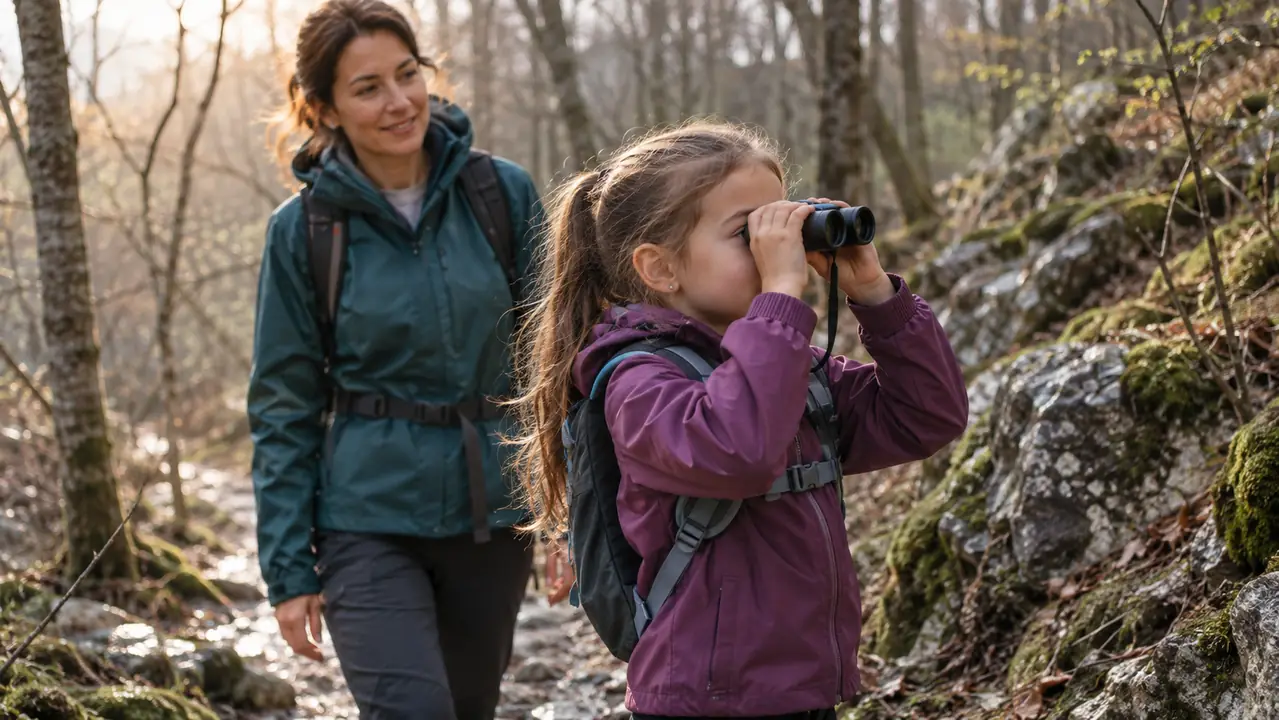
The first thing a curious child does on a trail is stop. Hattie is eight, and for most of the first mile of any walk she used to stop every few minutes to pick something up, point at something, or ask me what a sound was. None of that is a problem. The problem was that she could not see any of it clearly. A bird thirty feet up in a sycamore was a gray smudge to her, and after a while she quit asking about birds altogether. I noticed that before I noticed anything else.
That is the gap the Think Peak binoculars filled for us. I ordered them in February, on the same night I ordered four other things, after a Saturday that went badly enough that I sat in the car at the trailhead and made a list on the back of a receipt. Everything arrived within the week. Hattie has had those binoculars in her hands or in her pack on roughly thirty Saturdays since, through spring, a hot summer and now into fall. Her nature journal is at 31 species. The first bird she found on her own through the lenses was a pileated woodpecker at Mammoth Cave in March.
The Quick Verdict
A real 8x21 optic that fits an eight year old's hands and came through eight months of Saturdays with nothing loose or fogged. Small hands shake at 8x and the image goes flat at dusk, so treat it as a daylight tool.
Amazon Check Today's Price →The Pair That Turned a Blurry Bird Into a Journal Entry
8x21 magnification, BAK4 prisms, 8.8 ounces, about 4 inches by 4 inches. Small enough for a child to carry for two miles, real enough that she can name what she is looking at. This is the pair Hattie has used on about thirty Saturday walks.
Amazon Check Today's Price on Amazon →How I've Used It
On Mammoth Cave walks the binoculars ride in the main compartment of Hattie's pack, loose, on top of the rain jacket. She does not wear them around her neck on those walks because the strap swings against the pack and she finds it annoying. At Lost River Cave, where the paths are short and flat and the whole walk is under an hour, she wears them around her neck the entire time and stops whenever she likes. They are hers. I have looked through them twice, both times only to check that they were still working, and I handed them straight back.
Lost River is where they earn their keep. The woods there crowd close to the water and there is almost always something moving in the shrubs along the bank, so she can stop every fifty yards and find something without leaving the path. A walk that used to take twenty minutes now takes forty, and I have decided that is a feature and not a delay. She has logged more species there than at Mammoth Cave, mostly because the ground is easier and she is not spending the whole time watching her feet.
It is not all birds. She has used them on a beetle working along a fallen limb, on a squirrel that was too high to be interesting, and once, for about ten minutes, on a chip of mica catching the light in the rock face. That last one was not a bird but it was the closest look she has ever taken at anything, and it happened because the glass was in her hand and there was nothing else to do with it.
The routine that grew up around them was not my plan. Hattie keeps one spiral notebook, and every bird she can name goes into it with the date and where she saw it. That was my idea, left over from thirty-one years of teaching science to children who would rather be outside than at a desk. The binoculars made the notebook worth keeping. Before, she was writing down whatever I told her. Now she finds the bird herself, watches it until it moves, and then tells me what it was doing. Some of the entries are wrong. I let those stand.
I should be plain about the February business, because it explains why these are in our lives at all. We went out in old sneakers with a leaky plastic bottle in my tote and a thin poncho, and we turned back after about a mile with wet socks and a blister on Hattie's left heel. That night I ordered a pack, boots, these binoculars, a bottle and a rain jacket in one order. It was not considered gear research. It was a grandmother deciding that the Saturday walks were going to keep happening and needed to stop being miserable.
What 8x21 Means When the Hands Are Small
The listing gives 8x magnification and 21 millimeter objective lenses. In plain terms the bird looks eight times closer, and the front glass is small, which is exactly why the whole Think Peak unit weighs 8.8 ounces and measures about 4 inches by 4 inches. That is the reason these work for a child. An adult pair of 10x42 binoculars outweighs them by more than a pound and hangs off an eight year old's neck like a bag of sand. Hattie carries these for two miles without ever mentioning them.
The prisms are BAK4, the coating is on the prism, and the listing quotes a 384 foot field of view. What that means at Hattie's level is that once she gets a bird in the glass it does not immediately slide out of frame. A narrow field of view is the thing that makes children give up, because every small movement of the hand throws the bird away and they have to start the search over. These are forgiving enough that she can find a warbler in a shrub and keep it.
The barrels swivel, so the width adjusts to her face, and the center focus knob is covered in textured rubber, which matters more than it sounds. Her hands get damp and muddy. A smooth knob would have her wiping her palms on her jeans every thirty seconds. The eyepieces measure about an inch and a half across, which fits the space between a child's eyes without her having to press. She sets the focus herself. I have not adjusted them for her since April. The listing also notes a tripod mount, which we have never used and I doubt most families will.
The age range on the box says 3 to 12. I would call that generous at the bottom and fair at the top. A three year old cannot set eyepiece spacing or turn a focus knob with any control and will mostly enjoy holding the thing. Hattie at eight sits right in the middle, and I expect she will still be using this pair at ten, when her hands are steadier and the shake problem goes away on its own. Somewhere around eleven she will want more glass, and that will be a different purchase.
The Two or Three Saturdays It Took to Learn
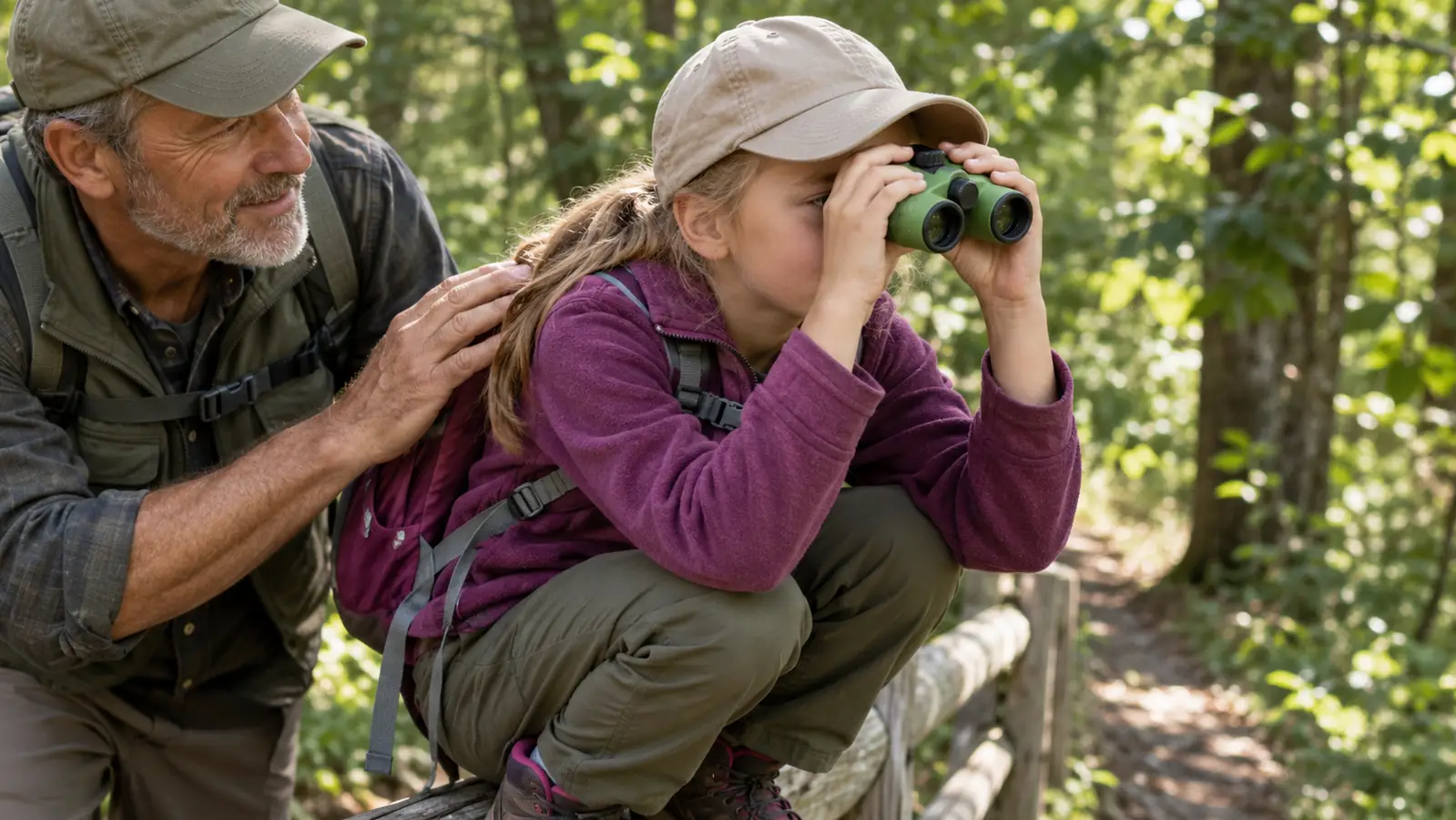
The first Saturday with them was not a success. Hattie held them to her eyes, announced that everything was blurry, and handed them back. She had the focus knob turned all the way in one direction and was trying to look at a bird while moving her head around. This is normal, and it is why I would not hand a pair of binoculars to a child and then walk on. The first twenty minutes need an adult standing right there.
What I taught her came out of the classroom, and I taught it to a great many children over the years. Look at the bird with your own eyes first and get your body pointed at it. Then raise the binoculars straight up to your face without turning your head. If you turn your head to hunt for the bird, you will be looking at a different piece of the tree by the time the glass arrives. She needed to hear that about four times before it stuck.
By the third Saturday she was finding birds on her own and getting them focused in a few seconds. The pileated woodpecker was that March, on a dead trunk maybe forty feet off the trail, and she watched it long enough that I got cold standing there. She wrote it down in the car. Her handwriting on that entry is worse than usual because she was excited.
Where They Struggle
Eight power is a lot for small hands. When Hattie holds them free the image swims. She has learned to brace her elbows on the rail at Lost River or lean a shoulder against a tree at Mammoth Cave, and then it settles. On an open stretch with nothing to lean on she cannot hold them steady for long, and she knows it now, so she does not try. I would not go above 8x for a child this age, and I would not go below it either, because at 6x the birds stay small enough that she loses interest in a hurry.
The second limit is light. With a 21 millimeter objective and a 2.6 millimeter exit pupil, these are daylight tools. Under a full canopy in deep shade, and in the last hour before dark, the image goes flat and gray and she stops being able to pick anything out. If the goal is owls at dusk, this is the wrong pair and no amount of patience will fix it. If the goal is a cardinal on a fence post at ten in the morning, it is exactly right.
The eyecups are fiddly. They twist up and down, and Hattie has never once bothered to set them, so they live wherever they were last left. It does not seem to change what she sees. It bothers me considerably more than it bothers her, which is usually a sign that it is not really a problem.
Living With Them, Eight Months In
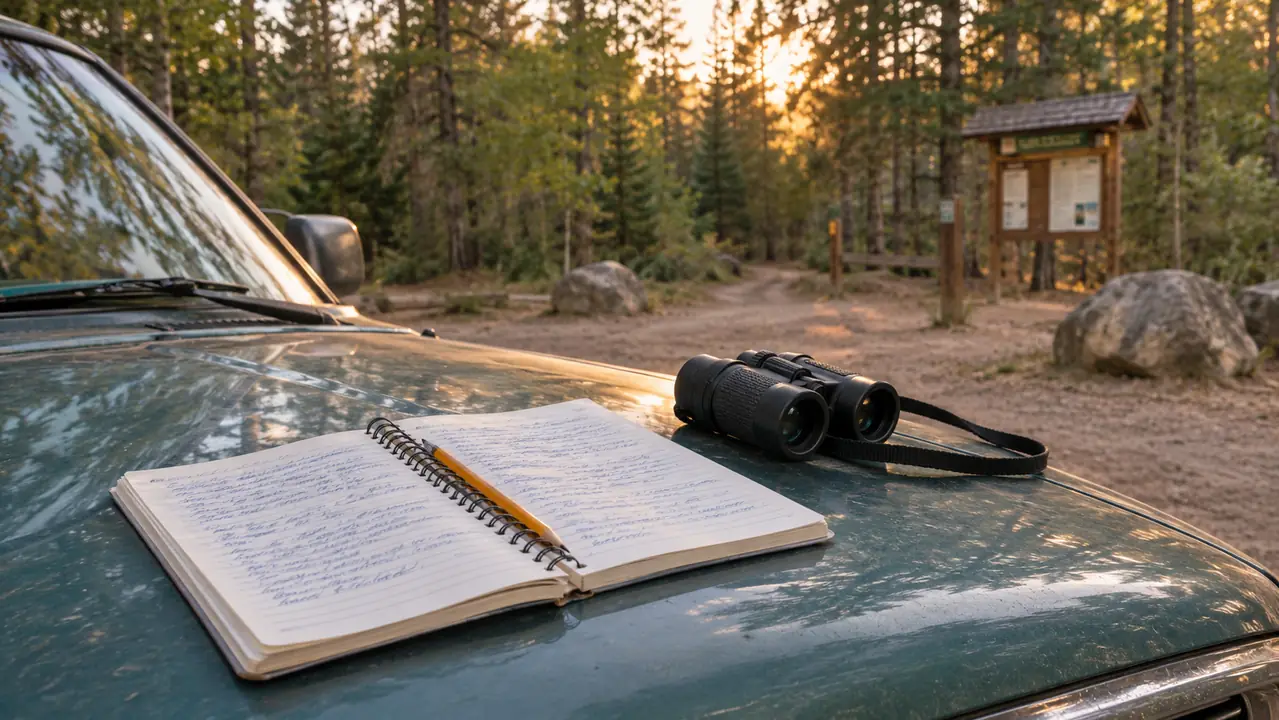
These Think Peak binoculars have been set down on wet limestone, dropped on rock, and stuffed into a pack on top of a rain jacket more times than I can count. The listing says they are built for rough handling, and eight months of Saturdays has not contradicted that. Nothing has come loose. Nothing has fogged on the inside. The hinge still holds the width she sets it to. I have not cleaned them properly once, which I am not proud of, and they still give a clear image.
Weather is the one claim I will not make for them. The listing says waterproof. All I can tell you is that they have been out in light drizzle a handful of times and came through fine, and that they have never gone into a creek or been left out in a downpour. I am not going to repeat a manufacturer claim as though I tested it myself.
When they are not in the pack they sit on the shelf by my back door, next to the notebook. That shelf is the whole reason they get used. Gear that lives in a closet does not come on Saturday walks. Gear that lives by the door gets grabbed on the way out, and Hattie grabs them without being told.
What I Liked
- 8.8 ounces and about 4 inches by 4 inches, so an eight year old carries them for two miles without complaint
- Real 8x21 optics with BAK4 prisms rather than a toy lens in a plastic shell
- The textured rubber center focus knob works with damp, muddy hands
- The barrels swivel to fit a child's face and the focus stays where she sets it
- A forgiving field of view, so a bird does not jump out of frame the moment the hand moves
- Came through eight months of drops, pack life and drizzle with nothing loose and nothing fogged
Where It Falls Short
- 8x is hard to hold steady in small hands, so she has to brace on a rail or a tree
- The small objective and 2.6 millimeter exit pupil make the image go flat in deep shade and at dusk
- The eyecups are fiddly and never stay where they were set
- I can only vouch for light drizzle, not for the waterproof claim on the listing
- A child needs an adult for the first twenty minutes or the blurry first look ends the interest
Before, she was writing down whatever I told her. Now she finds the bird herself, watches it until it moves, and then tells me what it was doing.
Who This Is For
This is for a parent or grandparent with a child somewhere between six and ten who already asks questions outdoors and has no way to answer them. It suits a child who will walk two or three miles if there is something to look at along the way. It suits the adult who is willing to stand still in the cold for ten minutes while a woodpecker is being watched. And it suits a family that wants the Saturday walk to teach something without it turning into a lesson. If your child has been borrowing your phone to take pictures of leaves, this is the natural next step.
Who Should Skip It
Skip it if your child is under five. The focus knob and the eyepiece spacing need hands and eyes that are further along, and a frustrated four year old will hand them back and never ask again. Skip it if you want to look at things at dusk, because the glass will disappoint you and there is no way around that. Skip it if the child has asked for something to look at the moon with, since this is not that. And skip it if you are buying it to keep a child busy on a walk they do not want to take. Binoculars reward curiosity. They do not create it.
Thirty-One Species and Counting, From a Pair That Fits a Child's Hands
8x21 magnification, BAK4 prisms, 8.8 ounces, about 4 inches by 4 inches. If your Saturday walk has a child in it who keeps asking what that bird is, this is the simplest way I know to let her find out for herself.
Amazon Check Today's Price on Amazon →