

Short answer: these are not the same kind of object, even though they share a shape. The GeoSafari Kidnoculars are a preschool toy with fixed 2x magnification and nothing to adjust. The Think Peak pair is a real compact binocular: 8x magnification, 21mm objective lenses, a BAK4 roof prism, and a center focus knob that a child has to learn to turn. Hattie is 8, and the Think Peak pair has ridden in her daypack on every Mammoth Cave walk since the first Saturday of March. If the child you are buying for is 3 or 4, the Kidnoculars are the honest pick, and I make that case further down.
I should be plain about how I know what I know. The Think Peak binoculars have lived in my house for about eight months, and I have watched one child use them on roughly 30 Saturday walks. I have never had the Kidnoculars on a trail. Everything I say about that pair comes from handling one on a store shelf in town and from reading the manufacturer's listing closely, and I will not dress it up as field testing. That distinction matters here, because the Kidnoculars' main argument is about the first five minutes in a child's hands, and I can only reason about that from the handling.
| Think Peak | GeoSafari Kidnoculars | |
|---|---|---|
| Magnification | 8x with 21mm objective lenses | Fixed 2x |
| Focus | Center focus knob covered in textured rubber; a child has to learn it | Focus-free, nothing to adjust |
| Glass and prism | BAK4 roof prism with prism coating | Toy lenses, no prism specification published |
| Field of view | 384 feet, as listed | Wide and forgiving in small hands |
| Weight and size | 8.8 ounces, about 4 by 4 inches | One molded plastic body sized for preschool hands |
| Eyecups | Fiddly, stiff on a cold morning, and they take a few tries | Large and soft, shaped for a small face |
| Rough handling | Compact optical body, eight months in a daypack without trouble | One molded piece with no knob to snap off |
| Age it actually suits | Listed for 3 to 12; in practice 6 or 7 and up | 3 and up, genuinely |
| Best for | A child who keeps a nature journal and wants names | A first pair for a very small child |
Where Think Peak Wins
Reach is the whole difference, and it shows up in one specific moment. In March, about a quarter mile up a Mammoth Cave surface trail, Hattie put the Think Peak pair on a pileated woodpecker working a trunk maybe 40 feet up and 30 feet off the trail. At 2x she would have seen a slightly larger dark bird on a tree. At 8x she saw the red crest, the white stripes on the face, and the way the bird hitches up the bark in short hops. That is the line between seeing a bird and being able to name one, and a name is what goes in the journal. The listed field of view is 384 feet, wide enough that she can find a bird she has already spotted with her bare eyes, which is the only way this works for a child.
The second thing Think Peak gets right is the glass. BAK4 prism, prism coating, a roof prism design in a body that measures about 4 by 4 inches and weighs 8.8 ounces. That is small enough to go in the main compartment of a kids daypack beside a folded rain jacket, and light enough that Hattie carried it all summer without complaining. The focus knob is covered in textured rubber, which sounds like a catalog detail until you watch a child try to turn a smooth knob with damp hands in October. Two limits I will state plainly. The eye relief is listed at 10.5mm, which is short, so a child who wears glasses will need to take them off or press in close. And the listing calls the binoculars waterproof, but ours have only been out in light drizzle, so I am not going to claim more than that.
The size is the part I underestimated. About 4 by 4 inches means it drops into the main compartment between the folded rain jacket and the notebook, and I never once had to rearrange the load to make room for it. On a Lost River walk, where the paths are short and the birds are close, she wears it around her neck on the strap instead, and at 8.8 ounces it does not pull at her the way I expected it to. That lightness is not a spec sheet number to me. It is the reason she was still carrying it herself in October instead of handing it to me halfway around.
Where GeoSafari Kidnoculars Wins
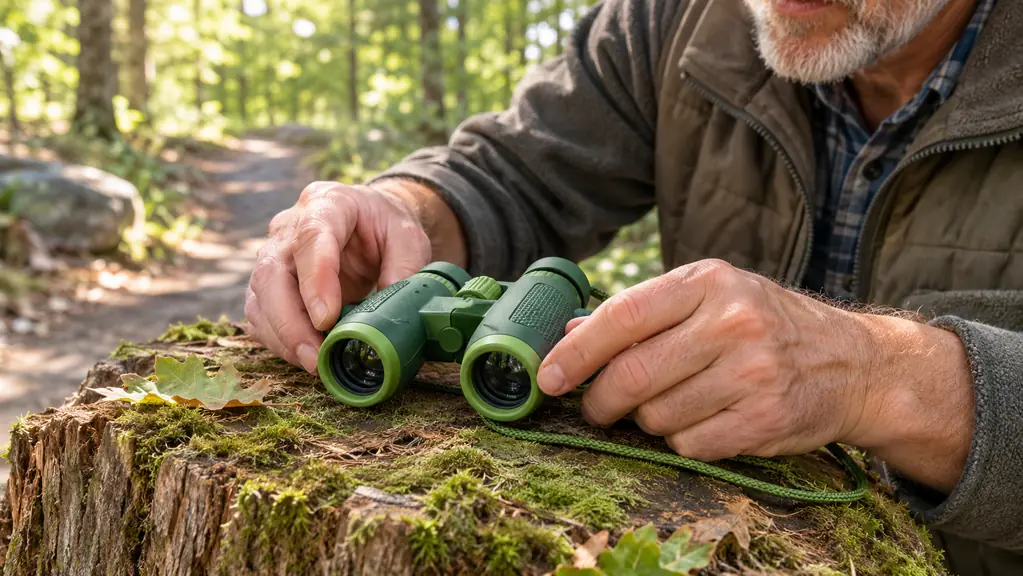
Focus-free is not a compromise for a very small child. It is the entire point. A 3-year-old cannot hold two eyepieces against her face, find a bird, and turn a knob with the other hand, and asking her to try is how you turn a five minute interest into a tantrum at the trailhead. The Kidnoculars have fixed 2x magnification and no adjustment at all, so the instruction is one sentence long: hold them up and look. I handled a pair on the shelf and the eyecups are large and soft, shaped for a small face in a way the Think Peak eyecups are not. The Think Peak eyecups are fiddly, and Hattie needed several tries before she stopped folding them shut by accident.
The Kidnoculars also win on being dropped. The body is one molded piece of plastic with no focus knob sticking out to snap off, and that is exactly what a preschooler needs. A 3-year-old drops things on gravel, on the stone steps at a trailhead, and out of a wagon. The Think Peak pair has survived eight months in a pack without trouble, but it is a compact optical instrument with a moving part, and I would not hand it to a child who still throws things when she is excited. Magnification cuts the same way in the other direction: 2x is steady in small hands, where 8x magnifies every wobble.
If she already asks what bird that is, buy the 8x pair
The Think Peak 8x21 has the reach to turn a shape in a tree into a bird with a name. BAK4 prism, center focus, 8.8 ounces, and small enough for the main compartment of a kids daypack. It is the pair that has been on every Saturday walk since March.
Amazon Check Today's Price on Amazon →What Eight Months in a Daypack Looks Like
The Think Peak pair lives on the shelf by my back door when it is not in the pack, and it has come out working on every walk since March. It rides in the main compartment, not around Hattie's neck, on Mammoth Cave days. At Lost River Cave, where the paths are short and the birds are close, she wears it around her neck and uses it constantly. The body has picked up the ordinary scuffs of a thing that gets set down on limestone, and nothing has loosened. The eyecups remain the weak point. They fold and unfold, and on a cold morning they are stiff enough that she hands the binoculars to me rather than fight them.
One July Saturday at Lost River I remember because it was already hot at nine in the morning. She found a pair of towhees scratching in the leaf litter maybe 20 feet off the path, and she crouched there for a good while with the binoculars up, then sat back on her heels and wrote it down. The notebook came out before the binoculars went back around her neck. I have watched a great many children handle classroom equipment over the years, and that order of operations, look first and record second, is the thing I was quietly hoping for back in February when I placed the order.
The honest part is that she uses them in bursts. Twenty minutes of serious looking, then they hang on her neck while she finds a millipede, then twenty more minutes. I have never had to coax her into using them, and I have also never had a walk where she used them the whole way. That is what eight months with an 8-year-old looks like. If you are imagining a child who scans the treeline for an hour, lower that expectation and you will be pleased with what you get.
At 2x a child sees a bigger bird. At 8x she sees the red crest and the way it hitches up the trunk.
The Focus Knob Is the Whole Lesson
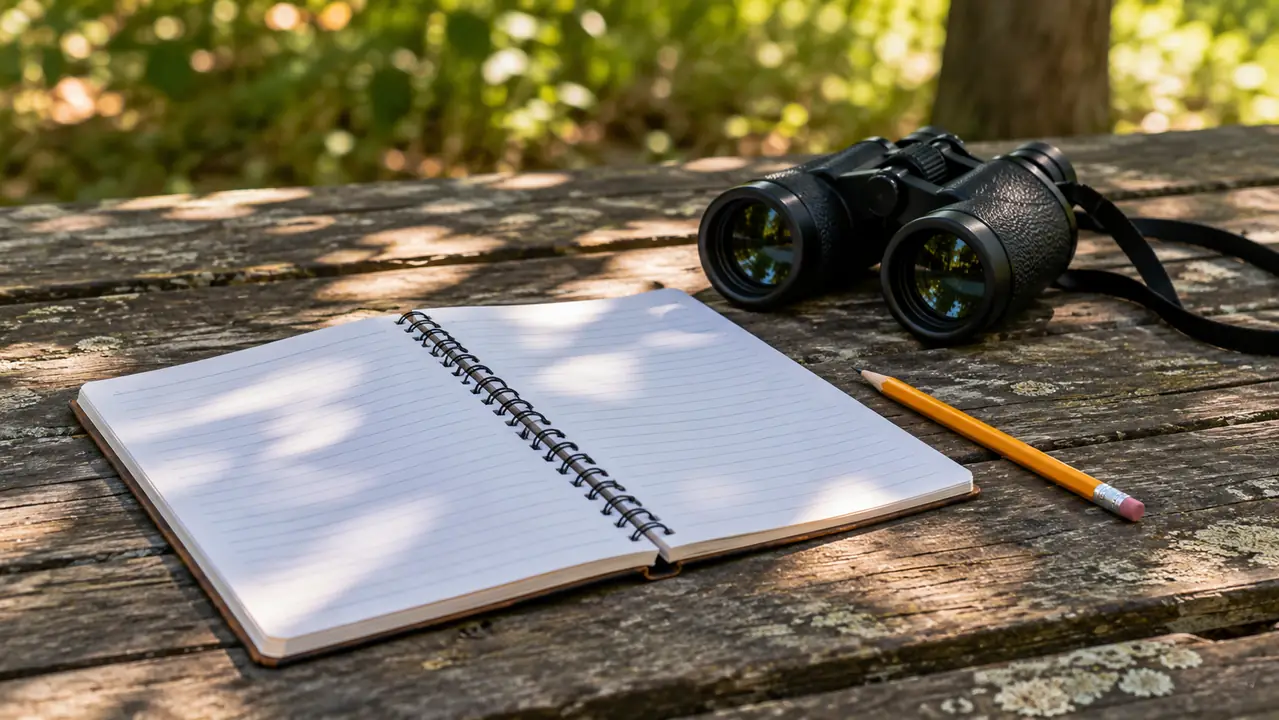
I taught third grade science for 31 years, so I have a bias here. I like a tool that makes a child learn something. The focus knob on the Think Peak pair is that tool. The method that worked was simple. Look at the bird with your bare eyes first, pick one leaf beside it as a landmark, then raise the binoculars without moving your head. Hattie needed two or three Saturdays to do it without help, and the first bird she found and focused on her own was a pileated woodpecker at Mammoth Cave in March. She wrote it in her spiral notebook that afternoon. Her list is at 31 species now.
The mistake we made first was letting her start with the binoculars already up. She swept the whole treeline that way, got turned around, and handed them back to me within a minute. The fix was to make her choose the landmark with her bare eyes and hold her head still while she raised them, which is much harder for an 8-year-old than it sounds and took two Saturdays of patient practice on a log beside the trail. Once it clicked for her it stayed clicked, and she has not needed the reminder since spring.
With the Kidnoculars, that lesson never happens, because there is nothing to learn. For a 4-year-old, that is a feature. For an 8-year-old who has started keeping a list, it is the difference between a toy and a piece of gear. I would not buy the Think Peak pair for a child who has shown no interest in naming what she sees, because the focus knob will feel like homework. I would buy it in a heartbeat for the child who already asks what kind of bird that is and gets a wrong answer from me.
The Dim Light Problem, Stated Plainly
Small objective lenses gather less light, and 21mm with a 2.6mm exit pupil is small. In open sun the Think Peak view is bright and clear. Under the deep shade of a hemlock stand, or at dusk when the woods go blue, the image dims fast and Hattie has to step out to the edge of the trail to keep looking. That is the trade for a body that weighs 8.8 ounces and fits in a daypack pocket. I mention it because a parent will notice it on the first evening walk and wonder whether the binoculars are broken. They are not. They are small.
Small hands also shake at 8x. She braces her elbows on a rail or leans into a tree trunk, and I have watched her work that out on her own without being told. The Kidnoculars do not need bracing, which is another reason they suit a younger child. If your grandchild is the kind who wants to look while walking, the 2x pair will give her a steadier picture and less frustration.
Who Should Buy Which
Buy the GeoSafari Kidnoculars if the child is 3, 4, or a young 5, if the child is rough with toys, or if you want a gift that requires no instruction from an adult. They are also the better choice for a grandparent who wants to hand something over at a trailhead and keep walking. Buy the Think Peak binoculars if the child is 6 or older, if she has started asking the names of birds, or if she keeps a notebook of what she sees. Hattie was 8 and already had the notebook when we ordered them in February, which is why they worked. For a careful 5-year-old with an adult sitting beside her on a log, the Think Peak pair is reasonable, but expect to do the focusing yourself for the first month.
If you only see the child a few times a year, the Kidnoculars are the safer gift, because the piece that makes the Think Peak pair work is a grown-up sitting nearby to teach the focus, and you will not be there. That is not a knock on the binoculars. It is a plain statement about who is doing the teaching, and it is worth being honest with yourself about before you order. A gift that frustrates a child in front of you is a worse gift than a simpler one she can use alone on the first afternoon.
Two last notes before you decide. If the child wears glasses, the 10.5mm eye relief on the Think Peak pair is a real annoyance and worth knowing before you order. And if the child has never shown any interest in what is up in the trees, neither pair will create that interest. The binoculars reward a child who is already curious. They do not manufacture the curiosity.
One pair, one Saturday, and a child who looks up
If the child in your life is 6 or older and has started keeping a list, this is the pair that rewards it. 8x21, BAK4 prism, center focus, 8.8 ounces. If she is 3, buy the Kidnoculars and come back to this in three years.
Amazon Check Today's Price on Amazon →