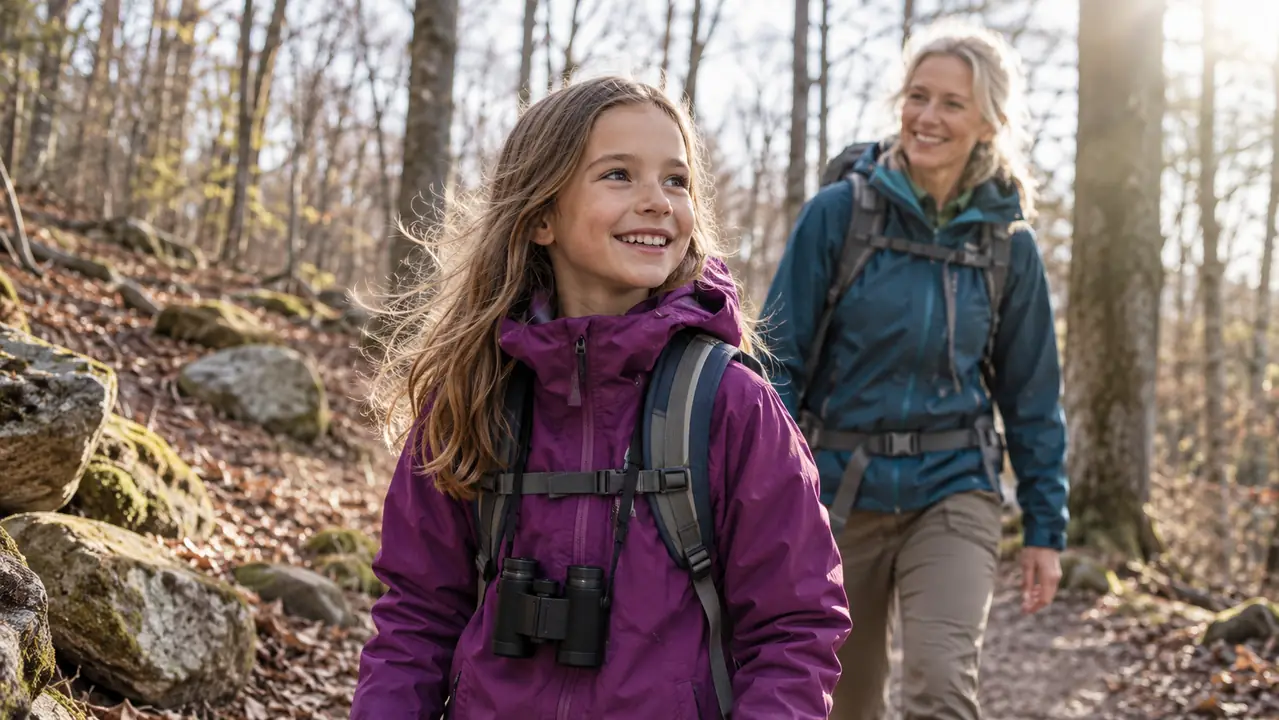
The first Saturday in March, Hattie and I stood at the edge of a surface trail at Mammoth Cave with a pair of Think Peak binoculars around her neck. She is eight, in third grade, and she had already told me twice that morning that walking was boring. I am her grandmother, Nora Pruitt, and I taught elementary school science for thirty-one years, so I have heard that sentence from a lot of children. I did not argue with her. I just pointed at a shape in the bare branches and told her to look with her eyes first.
The February before that, I had taken her to Mammoth Cave in old sneakers. I carried a leaky plastic bottle in my tote and a thin poncho that tore on a branch. Hattie got wet socks, a blister on her left heel, and she stopped about every ten minutes to ask me for water. We turned back after about a mile. That night I ordered five things in one Amazon order: a CamelBak pack, Merrell boots, the Think Peak binoculars, an Owala bottle, and a Columbia rain jacket. They arrived within the week. Nothing was bought separately.
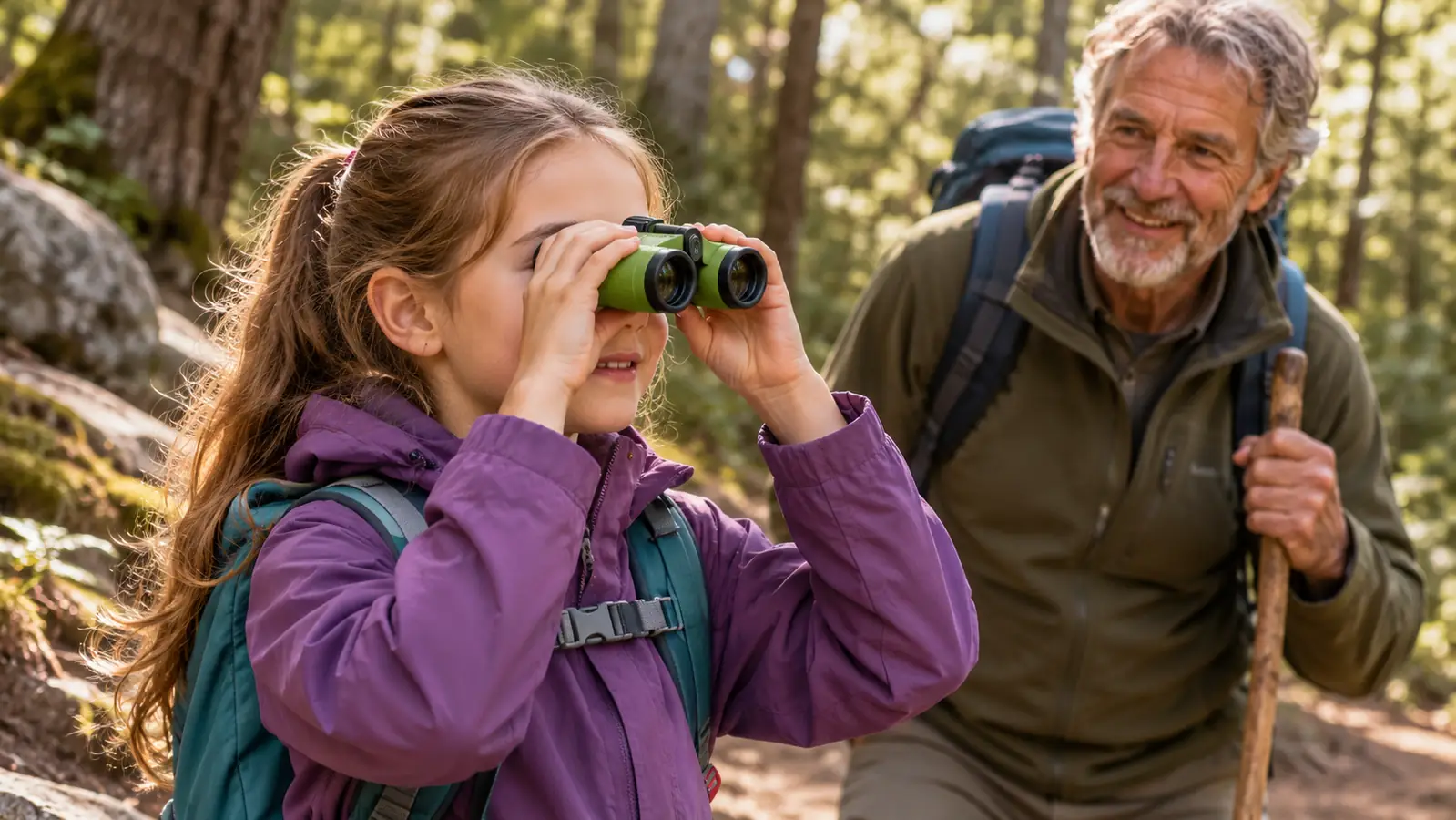
On the first Saturday in March we tried everything at once. The pack was the first change Hattie noticed, because she could sip while she walked and stopped asking me for water. The binoculars took longer. She held them to her eyes and saw a gray blur of bark. It took her two or three Saturdays to find a bird and focus fast. I taught her what I used to teach my students: look with your eyes first, find the shape, then raise the binoculars without moving your head.
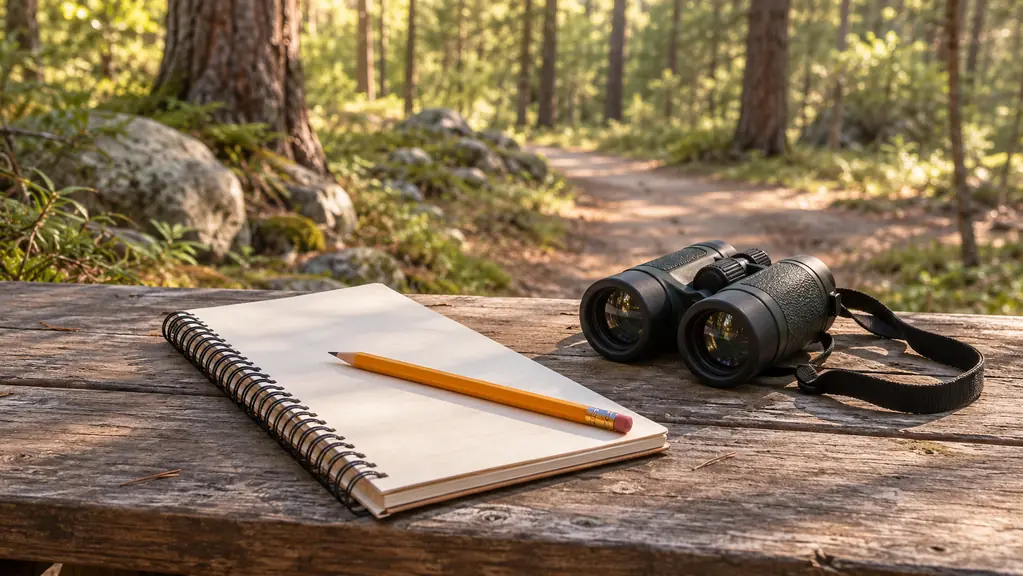
Her first clear look through the Think Peak binoculars was a pileated woodpecker at Mammoth Cave in March. She wrote it in the spiral notebook she keeps for what she sees, which was my idea from my classroom years. She is at thirty-one species now. Some are ordinary, like chickadees and cardinals. Some are not, at least to her. The notebook is not a school assignment. It is hers, and the binoculars are hers alone. I do not use them.
The binoculars are 8x21 with a BAK4 prism, 8.8 ounces, and about four by four inches. They ride in the main compartment of the pack on Mammoth Cave walks, and around Hattie's neck on the shorter paths at Lost River Cave in town. The center focus knob has a textured rubber cover, so her fingers can turn it without slipping. That sounds like a small thing. On a trail, small things are the whole thing.
Her first clear look through the Think Peak binoculars was a pileated woodpecker at Mammoth Cave in March. Her list is at thirty-one species now.
The pair that made a bird list out of a boring walk
Hattie carries the Think Peak 8x21 binoculars on every Mammoth Cave walk and every short Lost River path. They are small, 8.8 ounces, and built for a child's hands. If your Saturday walk needs a job, this is a good one: find something and name it.
Amazon Check Today's Price on Amazon →I want to be honest about what they do badly. At 8x, a child's hands shake, so Hattie learned to lean on a tree or a rail to steady them. They dim out in deep shade and at dusk, which is ordinary for small optics and not a fault I can fix. The eyecups are fiddly, and she sometimes folds them down on one side and not the other. She has used them in light drizzle only. I have never submerged them and I cannot tell you they are waterproof beyond what the listing says.
What they did for the walk is the part I care about. Since March, Hattie has done about thirty Saturdays with them. She used to walk with her eyes on her boots. Now she stops because she heard something in the leaves, and she raises the binoculars before she asks me what it was. That is a different child on a trail. The walking is still walking. She still complains when her feet get hot. But she has a job now, and the job is to look.
The pack matters here too, because the binoculars live in it. On Mammoth Cave walks they go in the main compartment and come out at every stop. On Lost River walks, which are under an hour, she wears them around her neck. The pack also carries the Columbia jacket, her notebook, and a snack. The Owala bottle stays in the Forester for the ride home on Mammoth Cave days. Water on the trail comes from the CamelBak. I am telling you this because a child's gear only works if it has a place. The binoculars have a place.
The rest of the order has held up. The Merrell boots are size 2 and she has about half a thumb left, so she will need the next size by spring. The Columbia jacket is a shell only, not warm on its own, and her pants got soaked in one real downpour in late April, but her top half stayed dry. The Owala got one small dent at Lost River in June and still holds cold. The binoculars have had no damage at all, though I would not call them tough in the way a boot is tough. They are a tool she has learned to handle. They live on the shelf by my back door when they are not in the pack.
What I'd Tell You If We Were Sitting at My Kitchen Table
I would tell you not to buy these as a toy to keep a child quiet. They are not that. A child has to be taught to look with her eyes first, then raise the binoculars without moving her head. That took Hattie two or three Saturdays. If you are not willing to stand still in the woods and wait while a child learns that, the binoculars will sit on a shelf. If you are willing, they give you a way into a conversation you cannot start by saying, 'Look at the trees.'
I would also tell you that thirty-one species is Hattie's number, not a promise. Some children will fill a notebook in a season. Some will look at one woodpecker and be done. Both are fine. The binoculars are 8x21, 8.8 ounces, with a center focus knob and a field of view listed at 384 feet. They are small enough for a child and real enough to show a bird's eye. That is the whole case. The walks are still two to three miles. The longest we have done is four. Hattie still asks for a snack. She just asks after she has looked.
A notebook, a trail, and a pair of binoculars
If you want to give a child a reason to stop and look, start with the Think Peak binoculars and a spiral notebook. The rest of the walk will take care of itself.
Amazon Check Today's Price on Amazon →