Before this spring, every Saturday walk with my granddaughter Hattie came with a soundtrack. Gravel crunching. Chickadees. And Hattie asking me for water every ten minutes.
I taught elementary science for thirty one years, so I know what a child looks like when she is finished with a walk. The asking was not really about thirst. It was about stopping. She would stop, I would swing my tote bag around, and hand down a plastic bottle that had begun leaking somewhere around the second mile. Then we would start again and lose whatever rhythm we had built.
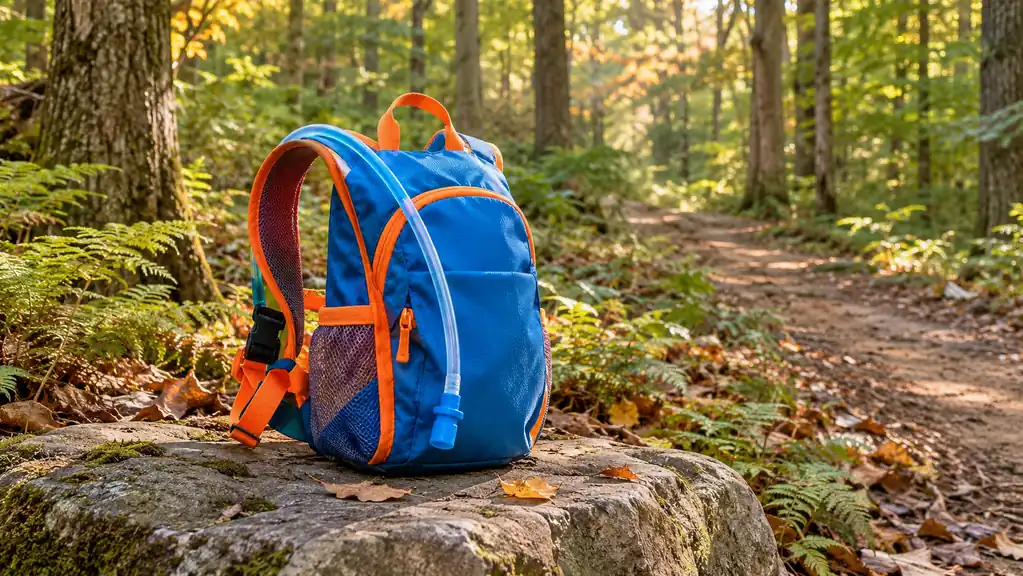
February was the one that broke it. Old sneakers. Wet socks. A blister on her left heel. A thin poncho that tore on a branch about a mile in. We turned around. That night I ordered five things in one Amazon order, and the CamelBak Mini M.U.L.E. was the first item in the cart. Everything arrived within the week. The first Saturday in March was our first walk with it, and it has gone on every Mammoth Cave walk since. Roughly thirty Saturdays now, through spring, a hot summer, and into fall.
The Quick Verdict
It ended the water stops on the first Saturday and has not missed a walk since. The reservoir is slow to dry and the sternum strap took Hattie a few weeks to manage. I would order it again tomorrow.
Amazon Check Today's Price →The One Thing From That February Order That Changed the Whole Morning
A 50 ounce reservoir, 3.5 liters of cargo, and a job an eight year old can do herself. This is Hattie's water on every Mammoth Cave walk.
Amazon Check Today's Price on Amazon →How I've Used It
The pack is two things at once. It is Hattie's water, and it is Hattie's job. The second part is the one I did not expect to matter so much. From that first Saturday in March she has put it on herself, filled it with me at the kitchen sink, and carried it the whole way. She is eight. She is in third grade. She is not a large child, and the pack itself weighs 7.05 ounces empty according to the listing, which is light enough that it never became a negotiation.
There was a handoff period I did not plan for. For the first three Saturdays I carried the pack out to the Forester and handed it to her in the parking lot at the trailhead, thinking she would want to start light and put it on at the last minute. By the fourth Saturday she asked to put it on in the driveway before we even left the house. That is what she does now. She puts it on, opens the zippered pocket to check what is in it, and rides the whole forty minutes to the park with it on her back. It is not what the instructions would tell you and it has not caused a single problem in eight months.
I fill the reservoir halfway, about 25 ounces, for any walk up to two hours. I only fill it all the way on the hottest days of summer. Fifty ounces is 1.5 liters, and a full one is simply a lot for a child that size to carry on her shoulders. Half is plenty for Mammoth Cave on a Saturday morning, and it keeps the load light enough that she forgets she has it on.
It goes on the Mammoth Cave walks, which run two to three miles, and once four. It does not go to Lost River Cave in town. Those paths are under an hour and she carries a bottle instead, and the CamelBak stays home on its hook. There is a version of this review where I tell you the pack is right for everything. It is not. It is right for the walk where she needs her own water and her own things for half a day, and that is what our Saturdays are.
What Changed on the Trail
Before the pack, she stopped every ten minutes or so to ask me for water. I would get the bottle out of my tote, hand it down, wait for her to drink, take it back, put it away, and start walking. Ten minutes later we did it all again. Each stop was small. Together they chopped the morning into pieces, and we never got far into anything before we stopped.
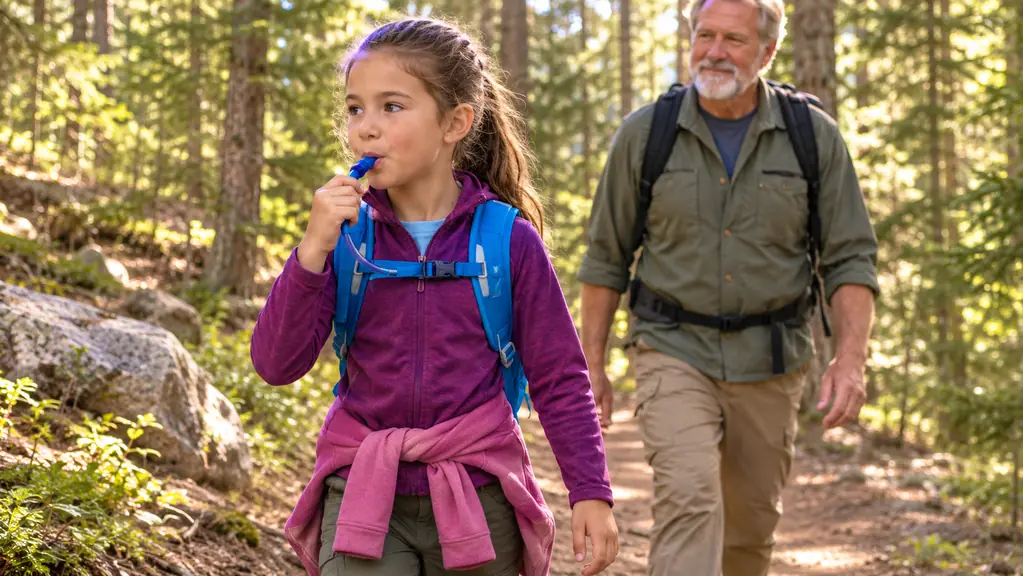
On the first Saturday in March, with the pack on and the reservoir half full, she reached back, brought the bite valve around, and drank while she walked. Then she kept walking. I did not stop. She did not stop. She asked me for water zero times that morning, and she has asked me zero times since.
The clearest comparison came on a warm Saturday in May, the kind of morning where the shaded limestone stays slick well past nine. On the old routine that first mile and a half would have produced six or seven stops, most of them mine as much as hers. Instead she drank at the quarter mile mark, again near the halfway point, and once more at the top of the rise before the bench. Three sips, no stops, each one taken without breaking stride. We covered more ground before noon that day than we ever had, and she was the one who said so out loud while we sat on the bench.
I am not going to tell you what that does for a child's body. I am a retired science teacher, not a doctor, and if you have questions about how much a child should drink on a hike, ask your pediatrician. What I can tell you is what I saw. She drank more often, in smaller amounts, without either of us breaking stride. And the morning stopped being about the bottle.
There was a smaller change I did not see coming. Because the water was hers and the pack was hers, she started treating the whole walk as hers. She checks the pockets before we leave the driveway. She decides what goes in the stretch pocket. It is a small amount of ownership, and it changed how she carried herself on the trail more than any pep talk I have given.
Filling It, and the Part Nobody Warns You About
Filling it is easy. The reservoir lifts out, the top opens wide, and it goes under the kitchen tap while Hattie is pulling her boots on. Half full takes about ten seconds. There is nothing fiddly about it and nothing to assemble.
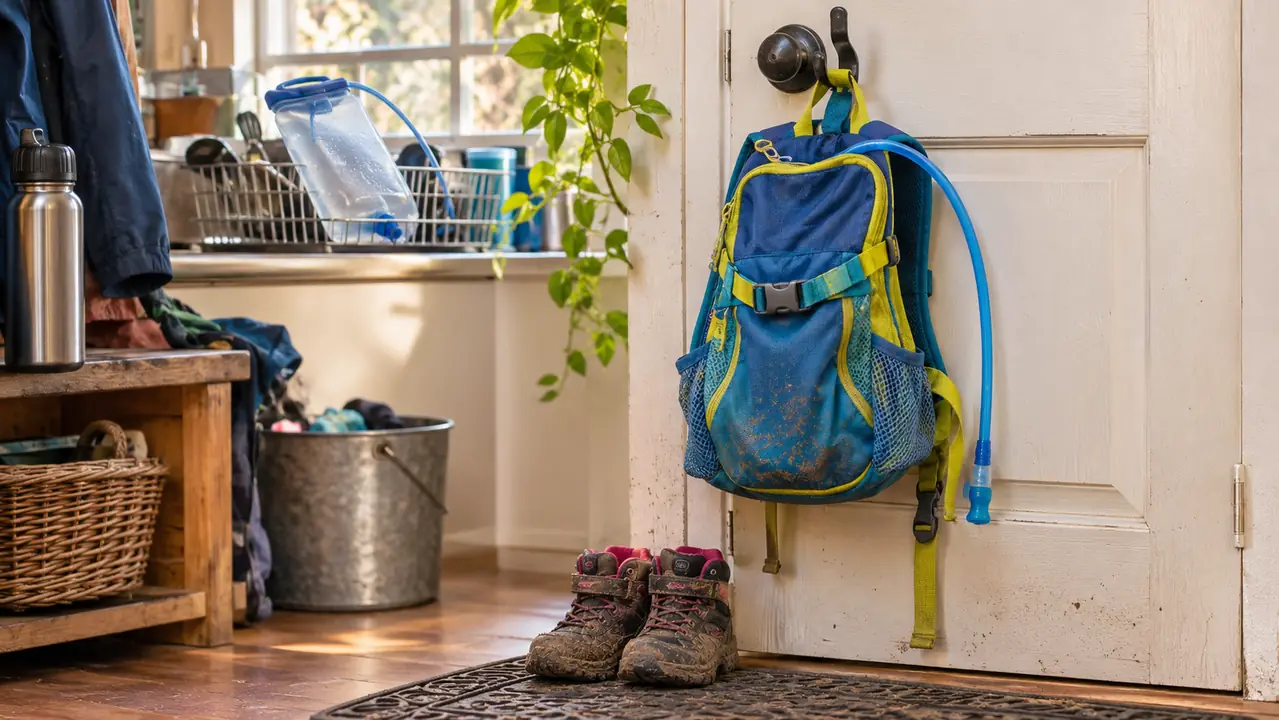
Drying is the slow part, and the listing does not mention it. A reservoir has to dry open or it starts to smell like a gym bag by August. Ours gets propped open on the dish rack overnight, and in humid Kentucky weather it takes two nights. The pack itself hangs on a hook by my back door. That is the entire routine: pack on the hook, reservoir on the rack. If you are not going to keep up with it, you will be unhappy by the second month, and it will not be the pack's fault.
I made the mistake exactly once, in June, and it was mine and not the pack's. I rinsed the reservoir at the sink, set it flat on the counter because we were late getting out the door, and did not think about it again until Tuesday. It was not ruined. It took a soak in warm water, a good rinse, and two full days on the rack, and then it was fine. But that was four days of a perfectly good pack sitting on a hook during a week of perfect weather. Now the rule in this house is that the reservoir goes on the rack before the boots come off, no exceptions.
The bite valve drips a little if she leaves it hanging open against her shirt. Not a leak, just a damp spot the size of a quarter. She has learned to push it shut. In eight months it has never once dripped inside the pack, and nothing in the main compartment has ever come out wet.
What Actually Fits In It
The cargo is 3.5 liters across three pockets, and for an eight year old that is more room than it sounds. On a Mammoth Cave morning it holds her rain jacket rolled up in the main compartment, the binoculars, her spiral notebook with a pencil, and a snack. The notebook and pencil go in the zippered pocket, which is the one that closes securely, so nothing spills when she swings the pack off her shoulder at a bench.
A typical Saturday load, so you can picture it: the rain jacket rolled tight and stuffed down at the bottom of the main compartment, the binoculars in their soft case beside it, the notebook and a pencil in the zippered pocket, a bag of trail mix or a cheese stick in the stretch pocket, and the bite valve routed over her right shoulder. It closes without a fight. In October I started adding a thin fleece, and that is where the 3.5 liters stops feeling generous. Jacket, fleece, binoculars, notebook, snack, and the pack is full. There is no room left for the sweatshirt she takes off at the second mile.
The stretch overflow pocket on the outside is my favorite part, because that is where the walk itself goes. A found leaf. A wet hat. A stick she has decided is worth carrying for a mile and then does not want anymore. It stretches, so it takes whatever shape the morning produces without her having to open the main compartment and repack everything.
The straps are shoulder straps and a sternum strap. There is no hip belt, and at this size that is fine. The whole pack is 7.05 ounces empty and measures 7.48 inches wide by 14.17 inches tall. It is polyester, so mud wipes off with a damp rag at the back door. It is not a pack I would put on a child much past ten or eleven, and it does not pretend to be.
The Parts That Took Longer Than I Expected
The sternum strap took Hattie a few weeks to manage on her own. It is a small clip, and small hands are not good at clipping anything behind their own chest. For the first month I clipped it for her at the trailhead. By April she was doing it herself, mostly on the first try and occasionally on the third. If you have a child who gets frustrated by buckles, plan on that month and do not make it a fight.
Her first solo clip was a Saturday in early April, and I remember it because she announced it. We were standing at the trailhead, she had the pack on, and she reached back and got the two halves together on the third try. She said, out loud, that she had done it. What helped was that I stopped reaching in to do it for her. I stood there with my hands at my sides for three Saturdays while she fumbled with it, which is harder than it sounds when you are sixty one and it would take you two seconds.
The reservoir is the piece that needs an adult, and I want to be plain about that. A child can drink from it. A child cannot reasonably rinse and hang it. That is my job, it takes two minutes, and it only stays two minutes if I do it every single time we come home.
One more honest note. Three and a half liters is a morning's worth of cargo, not a day's. Hattie carries her own things. She does not carry mine. My old daypack still goes with us and still holds my own water. The Mini M.U.L.E. was never going to replace it and does not try to.
CamelBak backs the pack with a lifetime warranty, which I have not had to use. Nothing has torn, no seam has opened, and the zipper on the secure pocket still runs clean after eight months of being yanked by a child in a hurry.
What I Liked
- Ended the every ten minute water stop on the very first walk
- 50 ounce reservoir fills halfway to about 25 ounces, which suits a small child
- 3.5 liters of cargo across three pockets holds a jacket, binoculars, notebook and snack
- The stretch overflow pocket takes whatever the child finds on the trail
- 7.05 ounces empty, light enough that she forgets it is on
- Hattie runs the sternum strap and the pockets herself, which was the point
Where It Falls Short
- The reservoir is slow to dry and has to be propped open overnight, sometimes two
- The sternum strap took a few weeks before she could clip it alone
- The bite valve drips a little if she leaves it hanging open
- No hip belt, so all the weight sits on the shoulders
- 3.5 liters is a morning's worth of cargo, not a full day's
She reached back, drank while she walked, and did not stop. She has not asked me for water since the first Saturday in March.
Who This Is For
This is for a child roughly six to ten who is old enough to carry her own water and wants to. The wanting matters as much as the age. Hattie wanted the job. A child who does not want a pack on her back will take it off in the first half mile and hand it to you, and then you are carrying two packs and answering the same questions you answered before.
It suits a morning walk of two to three miles where the child has a jacket, a snack, and something to look at through binoculars. It suits a household that walks the same trail most weekends and has settled into a rhythm, because the drying routine only works if it becomes a habit. And it suits a parent or grandparent who is tired of being the water dispenser for two hours.
Who Should Skip It
Skip it if your child is under about five. The pack will fit her, but the sternum strap, the bite valve and the rinsing all need hands and patience a four year old does not have. A bottle in your own bag is simpler and more honest, and there is no shame in waiting a year.
Skip it if you want one pack that carries everything for two people. It carries 3.5 liters and it is sized for a child. Skip it if you are not going to rinse and hang the reservoir, because a neglected reservoir is worse than the leaky plastic bottle you already own. And skip it if your walks are short walks on flat ground. At Lost River Cave we leave ours on the hook and she carries a bottle, and that is the right call for an hour in town.
Thirty Saturdays and It Has Not Missed One
If your child is old enough to carry her own water, this is the lightest way to let her. Half a reservoir, a jacket, some binoculars, and a morning that stops being about the bottle.
Amazon Check Today's Price on Amazon →