
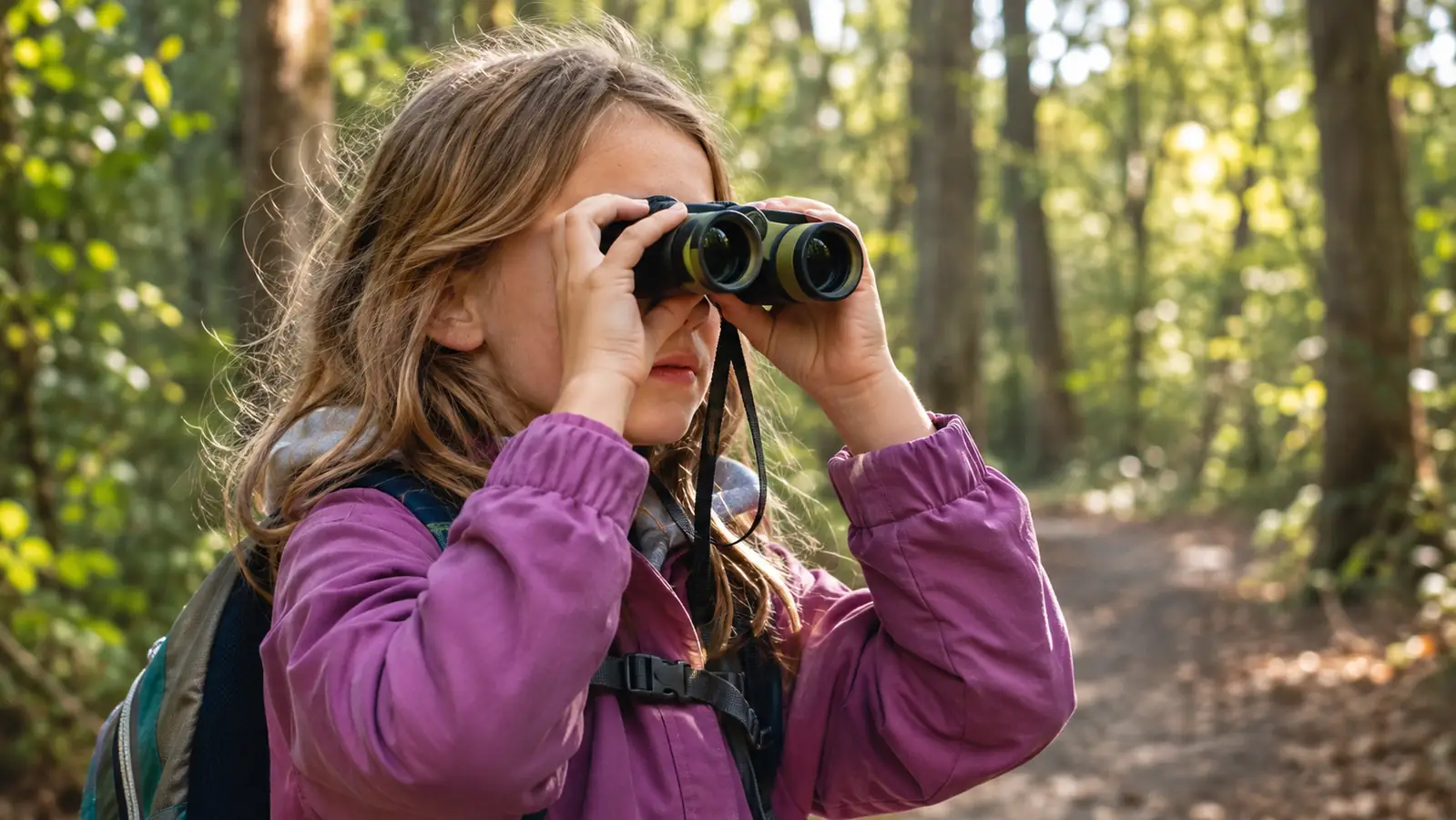
The first time I handed Hattie a pair of binoculars on a Saturday walk, she did not use them for a mile. She carried them in one hand like a purse. Then a chickadee landed on a branch above the trail at Mammoth Cave, and she stopped. She raised the barrels, turned the center focus knob, and went quiet in the way a child goes quiet when the world suddenly has more in it. She is 8, in third grade, and she has been my Saturday walking partner since she was small. I am her grandma, Nora Pruitt. I retired after 31 years teaching elementary school science, and I have seen what happens when a child has a tool that lets her look closer instead of only looking up.
The pair is the Think Peak 8x21. I ordered it in February with the rest of her gear, one order, and it arrived within the week. The first Saturday in March was the first walk with all of it. She has used the binoculars on about 30 Saturdays since, through spring, a hot summer and into fall. They are not a plastic souvenir pair. They have a BAK4 prism, a center focus knob covered in textured rubber, and they weigh 8.8 ounces. They measure about 4 by 4 inches. Hattie keeps them in the main compartment of her pack on Mammoth Cave walks and around her neck at Lost River Cave in town. They are hers. I do not borrow them.
The pair that turned a Saturday walk into a bird count
Hattie's list is at 31 species. The Think Peak 8x21 pair is the tool she carries. Check the current price on Amazon.
Amazon See the Think Peak binoculars on Amazon →A bird stops being a brown blur
Before the binoculars, every small bird was a brown shape that left too fast. Hattie would say bird and keep walking. With 8x magnification and a 384-foot field of view, she can find a cardinal in a cedar and hold it long enough to see the crest. The first bird she logged with the Think Peak pair was a pileated woodpecker at Mammoth Cave in March. She wrote the date and the place in her spiral notebook. That one entry changed the walk from a march to a search.
The trail gets a second layer above eye level
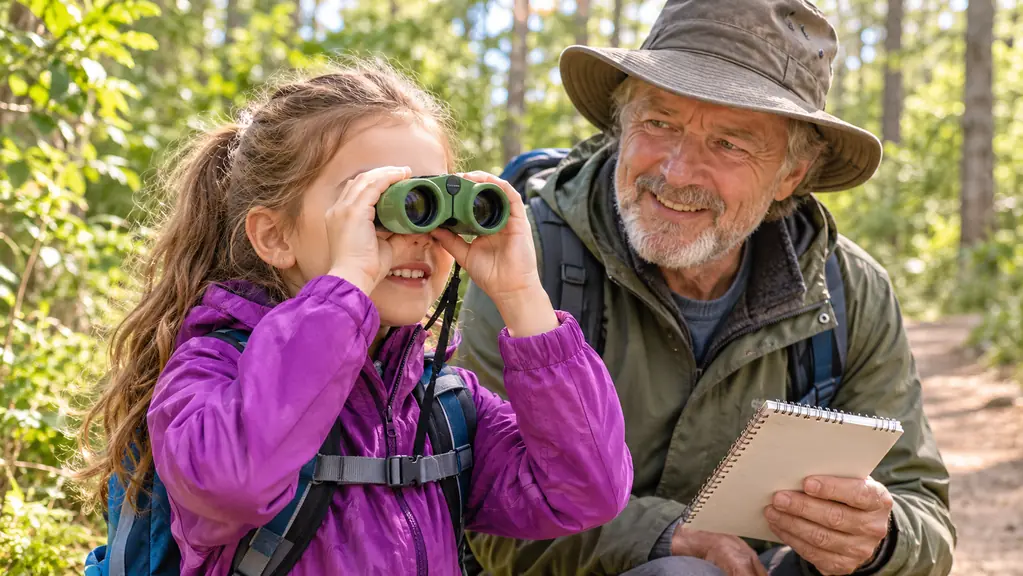
A child on a Saturday walk sees dirt, roots, and the back of an adult's legs. Binoculars add a layer above and beyond the path. Hattie started noticing nests, bark holes, and hawks riding a thermal over the ridge. She still walks. She just stops more often, and the stops are the point. A walk that is only about mileage is a chore. A walk with something to find is a place a child wants to be.
The focus knob gives small hands a real job
The center focus knob has textured rubber, which matters when a child has damp hands from a bottle or is wearing light gloves. Hattie needed two or three Saturdays to find a bird and focus fast. I taught her what I taught my students: look with your eyes first, then raise the binoculars without moving your head. Once she got it, she stopped asking me to look for her. She wanted to do it herself. That is the difference between a toy that entertains and a tool that teaches.
The nature journal fills up with proof
Hattie keeps one spiral notebook for what she sees. It was my idea, from my classroom years. The binoculars feed it. She writes the species, the weather, and one detail she would have missed. After about 30 Saturdays, her list is at 31 species. The notebook is not fancy. The habit is. A child who writes down what she sees is a child who is paying attention, and attention is the thing I most wanted to teach her on those trails.
8.8 ounces is light enough to forget
The Think Peak pair weighs 8.8 ounces. Hattie is 8, and she carries them in her pack on Mammoth Cave walks or around her neck at Lost River. She has never complained about the weight. That is the whole review. A tool that is too heavy becomes a negotiation. These are light enough that she forgets them until she needs them, and then they are right there. On a short walk in town, she wears them the whole time and does not fuss with them.
Her list is at 31 species. The first one she logged with the Think Peak pair was a pileated woodpecker at Mammoth Cave in March.

A reason to look up instead of down at wet socks
Most trail complaints from children start with looking down: wet socks, a loose rock, a hill ahead. Binoculars give a child a reason to look up. Hattie scans the canopy and the ridge line. On a hot July walk, she found a hawk circling above the trail and tracked it until it went behind the trees. The walk did not get shorter. It got more interesting. That is a better fix for a grumpy Saturday than a speech about how much fun we are having.
The pack routine holds for 8 months
We do not leave the binoculars in the car. They ride in the main compartment of Hattie's pack, and at Lost River they go around her neck. The routine is the same every Saturday: pack by the back door, binoculars in the pack, notebook in the zippered pocket. A tool that lives in the same place is a tool that gets used. This is not a complicated system. It is the only one that has held for 8 months, and I have tried enough systems with children to know that simple is what survives.
Small hands learn to steady the view
At 8x, small hands shake. Hattie leans on a tree or a rail when she wants a long look. That is not a defect. It is a lesson in how to use a tool. She has learned to brace her elbows, slow her breathing, and take the look she can get. The eyecups are fiddly, and she still needs help with them now and then. I would rather tell you that than pretend the pair has no limits. A child can learn the limits of a tool and still love using it.
The walk gains a shared vocabulary
Hattie and I now talk about birds by name. She knows a pileated woodpecker from a red-bellied. She knows the difference between a hawk and a vulture in the air. That did not come from a worksheet. It came from standing on a trail with a small pair of binoculars and a notebook. The walk has a vocabulary now. That is the part I did not expect. I thought I was buying a gadget. I was buying a reason to learn the names of things.
The drive home gets a report
On the drive home in the silver Forester, Hattie gives the report. She tells me what she saw, what she missed, and what she wants to find next week. Her parents, Ben and Carrie, work Saturdays, so the report is for me first. The binoculars give her something to report. A walk that ends with a story is a walk a child will take again. That is the real test of any gear you hand a child. It has to make the next Saturday easier to say yes to.
What I'd Skip
If you want a pair for yourself, skip these. At 8x and 21mm, they dim out in deep shade and at dusk. Hattie uses them in daylight. If your child is rough on gear, the pair is designed for rough handling, but ours have only been in light drizzle. I would not call them a rain tool, and I would not buy them for a child under 5 without close supervision, even though the listing says ages 3 to 12. The eyecups are fiddly, and the focus knob takes practice. None of that is a reason to skip the pair for an 8-year-old on a Saturday walk. It is a reason to buy the right tool for the right job and to keep your expectations honest.
A small tool that gives a child a reason to stop and look
Hattie has used the Think Peak 8x21 pair on about 30 Saturdays since March. They ride in her pack, they hang around her neck at Lost River, and they have filled a spiral notebook. If you want a walk to teach a child something, start here. Check the current price on Amazon.
Amazon See today's price on Amazon →