
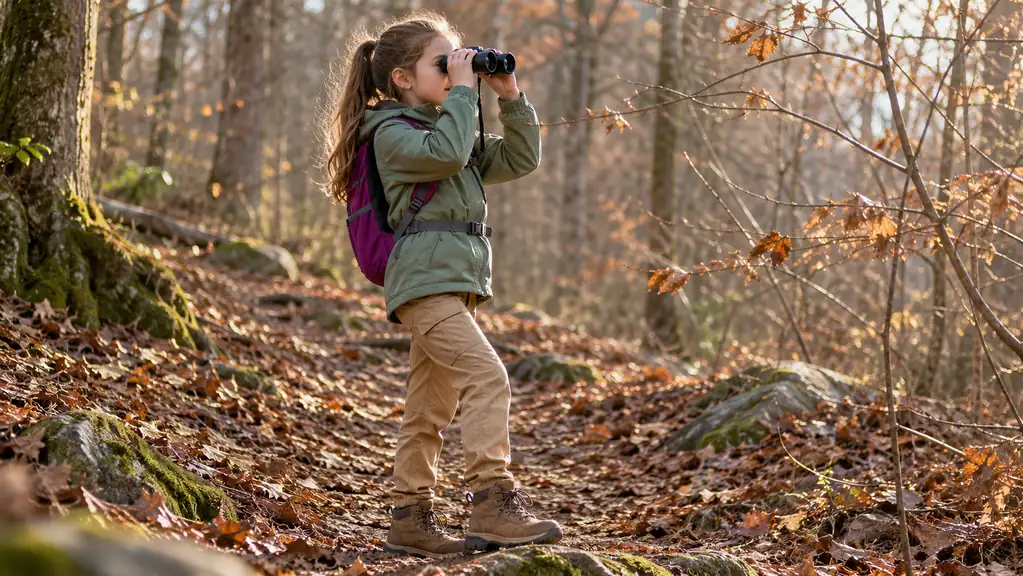
I bought the Think Peak binoculars for my granddaughter Hattie in February, in one order along with four other things, and I did not expect much from them. She was eight, in third grade, and the pair I kept in my classroom for thirty-one years weighed more than a bag of sugar and needed two hands, a steady shoulder and a patient adult standing behind the child. These arrived in a box not much bigger than a paperback, and she had them out of the wrapper before I had my coat off.
So this is the review I wish someone had handed me in February. Not whether they are nice. Whether an eight year old can actually use them, what they cannot do, which lines on the listing are generous, and which children will get nothing out of them at all. Hattie has carried them on about thirty Saturdays since, at Mammoth Cave and on the walking paths at Lost River Cave in town, and I have watched her closely enough to have opinions worth writing down.
The Quick Verdict
Light enough for a child to hold steady with something to lean on, sharp in the middle, and genuinely useful for a patient six to ten year old. Not a pair for a three year old, and not a pair for dusk.
Amazon Check Today's Price →The pair I would put in an eight year old's hands a second time
Eight months in, these are still the binoculars that live on the shelf by my back door and go into the pack every Saturday. If your child is six or older and willing to learn the focus knob, start here.
Amazon Check Today's Price on Amazon →What Changed After That February Walk
Last February I took Hattie to Mammoth Cave in her old sneakers, with a leaky plastic bottle rolling around in my tote and a thin poncho I had owned since before she was born. She had wet socks inside the first half mile, a blister on her left heel, asked me for water every ten minutes, and the poncho tore on a branch. We turned back after about a mile. That night I sat at the kitchen table and ordered five things at once, and the binoculars were one of them.
Before I ordered anything I thought about what I had seen in the classroom. Hand a heavy pair of binoculars to a child and she gets them up to her eyes, cannot hold them still, sets them down and loses interest inside four minutes. Weight is the whole problem, and no amount of instruction from a teacher is going to fix it. So I went looking for something under ten ounces, and the Think Peak pair at 8.8 ounces was the one that fit what I was after.
The first Saturday in March we went out with all of it. The boots got her attention first, because they were on her feet, but the binoculars were the thing she wanted in her hands before we left the driveway. She spent the first ten minutes looking at the mailbox through them and reporting that she could see the screws.
How the Binoculars Actually Get Used
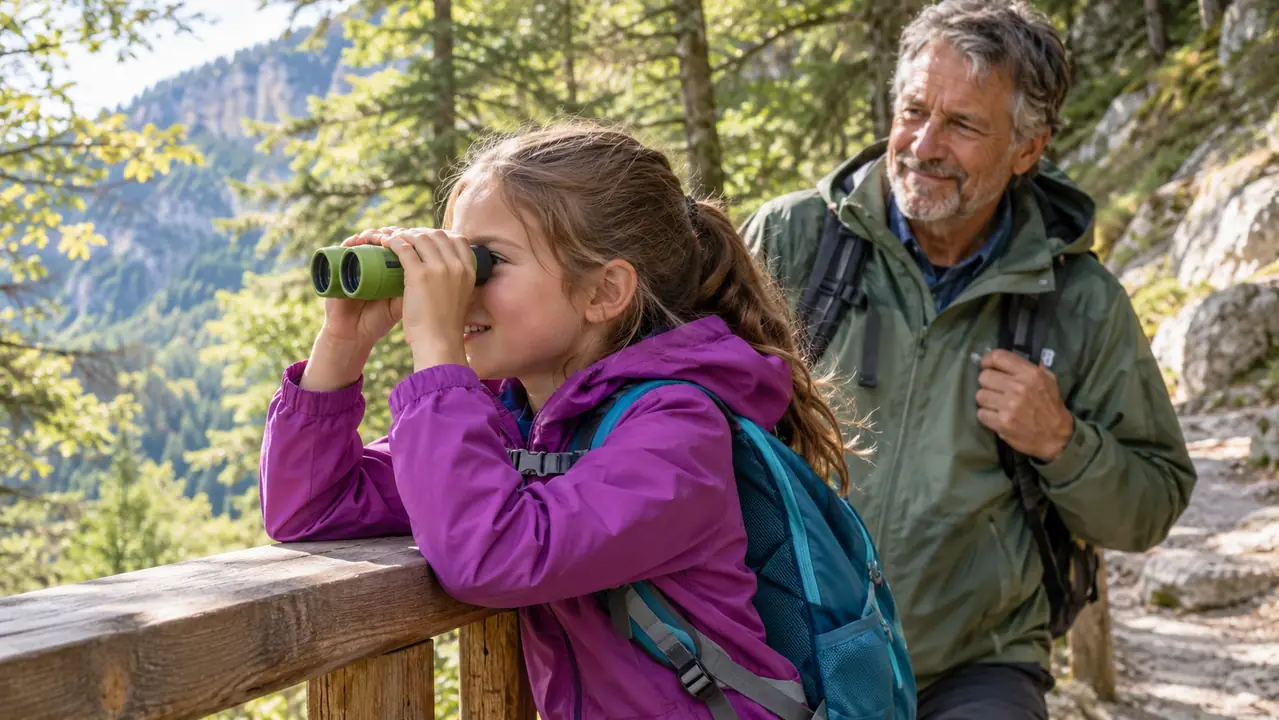
At Mammoth Cave they ride in the main compartment of her pack and come out when we stop, which is exactly what I wanted. On the shorter walks at Lost River, an hour or less, she carries them the whole way. They weigh 8.8 ounces, so this is not a hardship, and I have never once heard her complain about the weight of them, which is more than I can say for the boots.
On a Saturday in May at Lost River Cave she spent twenty minutes on a green heron at the far edge of the water, and that is the longest she has ever held still for anything in her life. The eyepieces measure about an inch and a half across, and the body is roughly four inches by four, so the whole thing disappears into her two hands. She can get her fingers around both barrels at once. That sounds like a small thing to notice. It is the reason she can hold them up for twenty minutes without her arms giving out, and the reason the heavy pair in my cabinet lasted four minutes.
The Think Peak binoculars are hers. I do not borrow them. Part of why she takes them seriously is that no adult on the walk reaches over and takes them out of her hands, and I would suggest you decide that before you hand them to a child, not after.
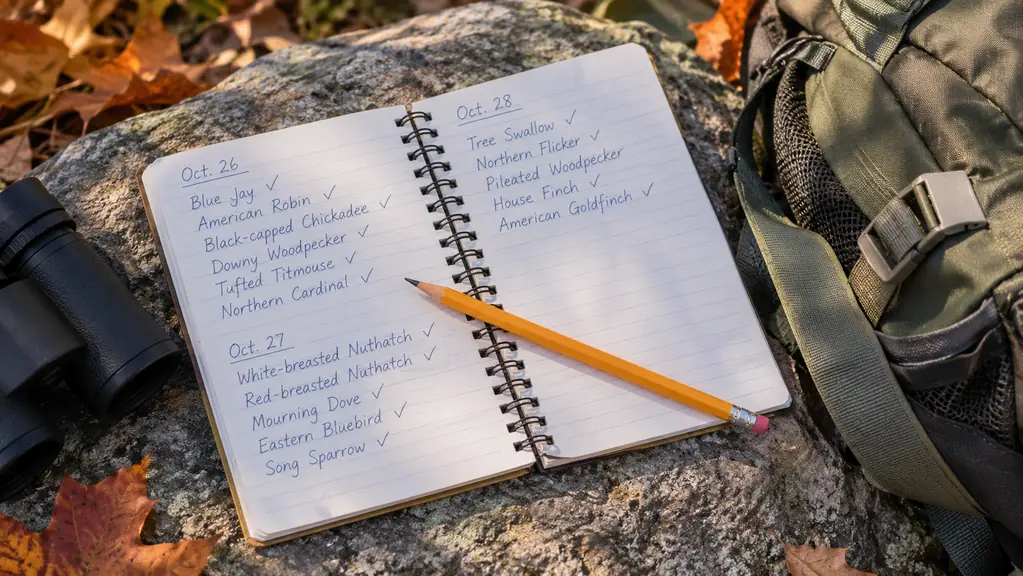
Her first bird with them was a pileated woodpecker at Mammoth Cave in March, which is an enormous bird to find with any binoculars and a piece of luck for a beginner. She wrote it in her notebook that afternoon. Her list is at thirty-one species now. Not every one of those was identified through the binoculars, but most were, and the notebook is the reason she keeps asking when we are going back.
What the Listing Does Not Say Out Loud
Eight power is a great deal of magnification in a four inch package, and the listing will not tell you what that costs you. A small person's hands shake. Hattie's do. At eight power the shake shows up in the image, so on a bird that will not sit still she has to lean on a tree or a trail rail, and if there is nothing to lean on she does not get a clean look. That is not a defect in the binoculars. It is what eight power does in small hands, and a parent who expects otherwise will be disappointed by every pair on the market.
Twenty-one millimeters of front lens does not gather much light. The exit pupil works out at 2.6 millimeters, which is a small window for the eye. In open daylight these are fine. In deep shade under a dense canopy, and in the last hour before dark, the image goes dim and flat, and Hattie hands them to me and says she cannot see. That is the honest limit of a compact pair and I would rather she learn it now than be told a small pair does everything.
The eyecups are the part I would change. They are small, they turn, and Hattie fumbled with them for the first several weeks. The eye relief is listed at 10.5 millimeters, which means anyone who wears glasses, myself included, has to take them off to get a full view. If you are a grandparent who plans to look through these as well, that is worth knowing before you buy rather than after.
The first several weeks were a running argument with those eyecups. She would get the bird in view, press the binoculars against her face, and knock an eyecup out of position with her own eyebrow, and then the view went black at the edges and she would hand the whole thing to me to fix. It happened three times in one morning in April and I lost my patience on the third. By June she had stopped doing it entirely. It was a matter of her hands learning a smaller motion, not a matter of the eyecups being badly made, though I still would have made them bigger.
The listing calls them waterproof. Ours have been out in light drizzle more than once and came through it with no fogging and no trouble. They have never been dunked in a creek, I have not tested them that way, and I will not claim they would survive it. Treat the word as a modest promise rather than a guarantee and keep them out of the water.
The box says ages three to twelve. Three is optimistic. A three year old cannot turn a center focus knob with any purpose and the eyecups will be a fight every single time. Six is realistic, ten is realistic, and somewhere around eleven a child starts wanting more magnification and more light and these will begin to feel like a step down. I would call them a six to ten pair that a bright four year old might enjoy with a great deal of help.
The Part That Took Three Saturdays
It took Hattie two or three Saturdays to find a bird and get it in focus quickly, and that is the part nobody warns you about. The instinct is to put the binoculars to your eyes and hunt around for the bird, which is miserable. What works is the opposite. Find the bird with your eyes, keep your head perfectly still, then raise the binoculars without moving your head at all. We practiced on a fixed target first, a knot on a trunk, then on a feeder. Once she had it, she had it for good.
It took three Saturdays before she could find a bird and focus on it before it moved. Now she does it in about two seconds, and there are thirty-one species in her notebook.
Now she finds things fast, and she has started telling me what she hears before she looks, which I never taught her. What she still cannot do is follow a bird in flight. The field of view is listed at 384 feet, which is wide enough to locate a bird sitting still and narrow enough that a warbler in a treetop takes real work.
Where They Are Genuinely Sharp
The glass in these Think Peak binoculars is better than I expected, and I say that as someone who spent thirty-one years squinting through school supply optics. The prisms are BAK4, the body is a roof prism design, and the focus is a center knob with a textured rubber cover. When Hattie gets it dialed the center of the image is genuinely sharp. She counted the lobes on a white oak leaf at about fifteen feet and got the number right. She read the small print on a trail sign at a distance where I could not.
There is a sign at the trailhead with a paragraph of small print on it about not feeding wildlife. From where the gravel meets the boardwalk, roughly twenty-five paces away, Hattie read me the last sentence of it before I could make out the first word. She was insufferable about that for the rest of the walk, and I let her be. The focus knob turned to that setting and stayed there for the next half mile, and she only had to nudge it twice the whole way.
Sharp in the middle is not the same as sharp at the rim, and these do soften a little at the edges, which is normal and which no child will ever notice. The barrels swivel to set the width for her eyes and stay where they are set. The focus knob has enough resistance that it does not drift on its own and light enough that she can turn it without bracing her whole arm.
What Eight Months of Handling Has Done
These have ridden in a pack, been set down on limestone, been knocked around in the bottom of a tote and handed back and forth between a child and a grandmother who is not always careful. They still focus smoothly and the hinge still holds its position. Nothing has come loose and nothing rattles. The rubber on the focus knob is the only part with real texture to it, and it has not worn shiny in eight months of use.
There is a threaded mount on the underside, which almost nobody uses on a child's binoculars and which I have used twice. Screwed onto a small tripod set on the porch rail, they become a fixed scope for watching the feeder. A child who is fighting the shake can get a completely still image and learn what sharp actually looks like. It is the least discussed feature on the pair and one of the more useful ones.
What I Liked
- Sharp in the center at eight power with BAK4 prisms, which is more glass than most children's pairs carry
- 8.8 ounces and about four inches square, so an eight year old carries them all morning without complaint
- Center focus knob with textured rubber that a child can turn and that does not drift on its own
- The barrels swivel to fit a child's eye width and stay where they are set
- A threaded tripod mount that turns them into a still scope for a child fighting the shake
Where It Falls Short
- At eight power a small child's hands shake and the image wobbles unless there is something to lean on
- 21 millimeter lenses go dim in deep shade and in the last hour of daylight
- The eyecups are fiddly for small fingers, and the 10.5 millimeter eye relief means glasses come off
- Listed as waterproof, but ours have only seen drizzle and I cannot vouch for more
- The three to twelve age range on the box is generous at both ends
Two Things I Got Wrong
I assumed Hattie would need a grown up's binoculars held for her, because that is what my classroom pairs required. I was wrong. What she needed was a pair light enough to hold on her own and cheap enough in spirit that I would not flinch when it went into a pack. Being able to use them without me standing behind her is the entire point, and a heavier pair would have taken that away.
I also assumed that anything this small would be junk glass, because in my experience small binoculars usually are. These are not. The center of the image is clean and the focus holds, and the only real complaints I have are about light and shake, which are the physics of a compact pair rather than a fault in the build. I was ready to be dismissive and I was wrong about that too.
Who This Is For
This is for a child of about six to ten who will stand still for two minutes because something is moving in a bush. That child gets a real tool, a notebook habit and a reason to keep walking to the next bend. It also suits the adult who wants a pair that lives in a pack and does not need to be worried over, handed to a child on a wet log without a lecture about being careful.
It suits grandparents in particular, because the binoculars give you something to talk about on a walk besides how much farther it is. Hattie and I have had better conversations about woodpeckers than about anything else in eight months.
Who Should Skip It
Skip it if your child is three or four and wants to look at everything quickly, because the focus knob will defeat them and you will end up carrying the binoculars. Skip it if your walks happen at dusk or in heavy timber, where the small front lens will leave you both squinting. Skip it if you want one pair the whole family shares, since the eye width and focus will need resetting every time it changes hands. And skip it if you want a pair that can go in the water, because ours have not been tested that way and I will not pretend otherwise.
What I Would Do Again
I would order the same pair on the same night, in the same box with the boots and the pack and the bottle and the jacket. Eight months and about thirty Saturdays later, the binoculars are the item that turned the walks into something Hattie does rather than something I take her on. That was not the plan when I was standing in my kitchen in February feeling like a fool. It is the result.
Eight months, thirty Saturdays, thirty-one species in a notebook
They are sharp where it counts, light enough for an eight year old to carry, and honest about their limits in low light. If that matches the child you walk with, this is the pair.
Amazon Check Today's Price on Amazon →