
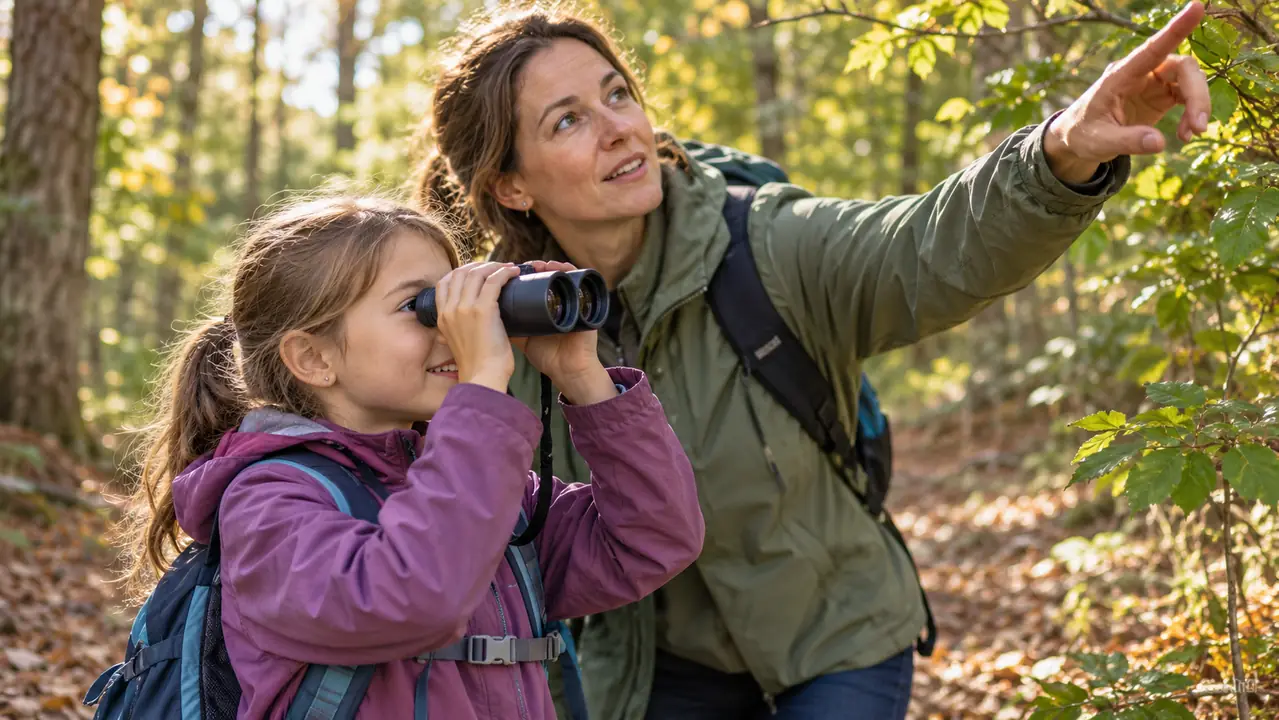
The first Saturday I handed Hattie my bird book and a pair of binoculars, she did what every child does. She put the eyepieces to her face, said she could not see anything, and handed them back. She had been looking at a wall of trees, not at a bird. Nobody had taught her the order of operations.
That is the whole problem in one sentence. Children do not fail at bird watching because they are too young or because their binoculars are too cheap. They fail because nobody shows them that the eyes come first, the binoculars second. Once you teach that sequence, an 8-year-old can find and focus on a bird in a few seconds, and then you cannot get the binoculars back. Hattie uses the Think Peak 8x21 pair we bought in February. She has been out with them on about 30 Saturdays since, and the method below is the one that got her from frustrated to a written list of 31 species.
The pair that finally got a warbler in focus on the first try
Small enough for an 8-year-old's hands, with a center focus knob she can grip in gloves. Hattie's are hers alone, and she has used them on every Saturday walk since March.
Amazon Check Today's Price on Amazon →Before You Start: Three Things to Settle First
Pick the wrong day and no method will save you. Leaves in full motion, a hot afternoon, a group of five children, any of these will end the lesson in ten minutes. What you want is a cool morning after rain has stopped, when the leaves are still and the birds are feeding low and moving slowly. At Mammoth Cave, that means getting to the surface trail early and staying on the flat sections rather than pushing for distance.
Second, set the binoculars up before the child touches them. Every pair has a hinge between the barrels, and it needs to be set to the width of that particular child's face. Do it for them the first several times so they never learn to fight the hinge while a bird is getting away. On the Think Peak pair the barrels swivel easily, which is a help here, but easy-swiveling also means they drift, so check the width at the start of every walk.
Third, agree on the goal. If the goal is a list of ten new birds, the child will be disappointed by 9:40 in the morning. If the goal is one bird looked at properly, the walk is a success by 9:20. Hattie and I settled on one. That is why her journal, and not a count of miles, is the record of these walks.
Step 1: Teach the eyes first, then the hands
This is the step that fixes almost everything, and it takes about five minutes on the first walk. Sit down somewhere with a clear view. Find something large and still, a signpost, a dead branch, a parked car. Have the child look at it with bare eyes and keep looking at it while they raise the binoculars up to their face without moving their head.
The head does not turn. Only the arms move. Say it out loud every time for the first few walks, because the instinct to swing the whole head around and hunt through the lenses is very strong and it never works. If the child moves the head, the binoculars sweep past the target and then they are searching an empty green blur and they will hand the binoculars back to you.
Practice on three still objects before you attempt a bird. Hattie and I did a trail marker, a drip line on the cave entrance, and the top of a cedar. By the third one she had it, and the difference in her patience afterward was immediate. It sounds too simple to matter. It is the single thing that matters most.
The first thing I tried, back in February, was standing behind Hattie with my hands on her shoulders and steering her toward the bird. That failed for a reason I should have predicted from the classroom. She could feel me pushing, so she stopped looking and started waiting to be aimed, and she learned nothing at all. The still-object practice replaced it entirely, and it worked in a way the steering never did because she was the one doing the aiming.
Step 2: Set the focus once, then let the child own the knob
Most adults focus the binoculars for the child and then hand them over. That is a mistake. Focus belongs to whoever is looking, because eye spacing and eyesight differ, and because a child who never turns the knob never learns what sharp looks like. Hattie's eyes and mine are different enough that a setting which was crisp for me was a soft blur for her, and we lost most of one March walk before I worked that out.
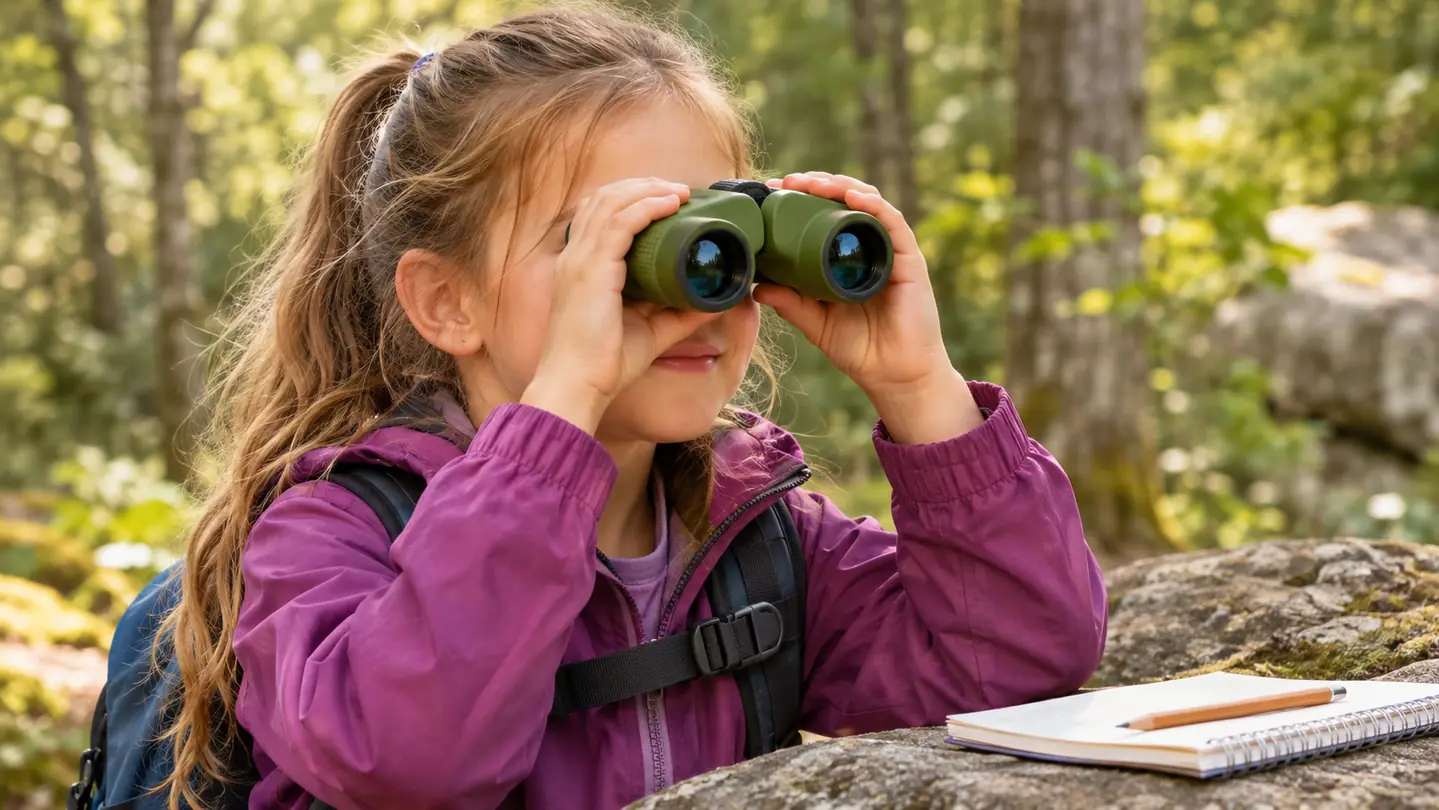
Instead, do this. Have the child close one eye, look through one side only at a still object about 30 feet away, and turn the center focus knob until the edges of the object go crisp. Then have them open both eyes. On the Think Peak binoculars the focus knob is covered in textured rubber, which matters more than it sounds, because small hands in cold weather otherwise slip on a smooth knob and overshoot.
Then hand over the whole job. When a bird goes blurry, the child turns the knob. Not you. It took Hattie two or three Saturdays before she could do this quickly enough to catch a moving bird, and there were walks in March where she missed three birds in a row and got quiet about it. That passes. Expect it and do not fill the silence with instruction.
Step 3: Practice on the birds that hold still
Do not start with warblers. Start with whatever in your area sits in the open and stays put. At Mammoth Cave that means woodpeckers on trunks, a cardinal on a bare branch, a hawk on a snag across a field. Hattie's first bird through her own binoculars was a pileated woodpecker in March, and it was a good first bird because it was loud, big, and busy on a trunk at eye level rather than overhead.
Give the child the location in plain words, and use a clock face or a straight arm rather than pointing with a finger, since a finger is too short a vector to follow into a treeline. Say "straight up from the white oak, halfway to the top" and then wait. Do not keep talking. The child needs the quiet to hear the bird and find it. On a cold morning later that same month we stood in one spot for eleven minutes because a downy woodpecker kept working around the far side of a trunk and reappearing, and she never once asked to move on. The bird was doing the teaching and I was only keeping the time.
When the bird moves, resist the urge to relocate it for them. Wait ten seconds. Children get better at tracking fast when they are allowed to lose a bird and find it again. If they lose it twice in a row, find a new bird rather than drilling the same one.
Step 4: Give the child a job that produces a record
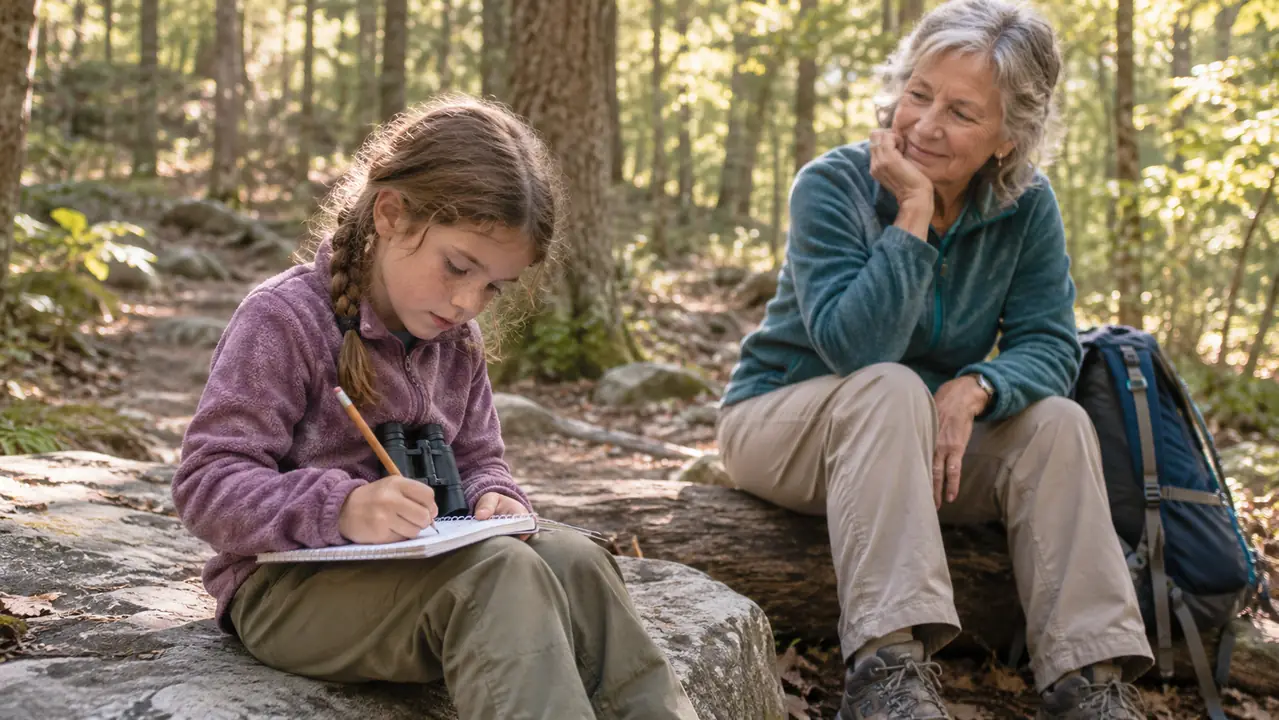
Hattie keeps one spiral notebook, and it was my idea, carried over from 31 years of classroom tables. The rule is simple. If she can name it, it goes in the book with the date and where we were standing. If she cannot name it, she writes a description of what she saw and we look it up at home.
A notebook changes the walk. A child who is writing something down is a child who is paying attention to a detail rather than to the general idea of being outdoors, and it gives the Saturday a shape that does not depend on how far you walked or how many birds showed up. Her list is at 31 species. That number is hers, not mine, and she knows exactly which ones she found.
Keep the writing short and outdoors. Two lines is plenty. If a child wants to draw the bird instead of naming it, let them, because a drawing forces a closer look than a name does. Bring one pencil, not a case of them, and keep the notebook in the same pocket of the pack every single week so nobody spends the first mile of the walk looking for it. Her first page is dated the first Saturday in March and holds four entries, two of them spelled wrong. I have never corrected the spelling in that book. It is her record, and a corrected record is a record a child quietly stops adding to.
Step 5: Teach the limits of the tool, honestly
An 8x21 binocular is a small instrument and it will show its limits. At 8x, small hands shake enough that a distant bird swims, so teach the child to brace against a tree trunk, a rail, or the top of a fence post. Hattie leans on the nearest trunk without being told now, and it made a bigger difference than any advice I gave her.
The second limit is light. In deep shade and near dusk, a small binocular goes dim and the bird becomes a shape. That is not a defect, it is what a compact pair does, and telling a child so in advance prevents the conclusion that they are doing it wrong. On gray mornings we look at birds in open light and save the deep woods for another day.
The third limit is the eyecups, which are fiddly on the Think Peak pair and take a bit of fussing to sit right against a small face. Check them before the walk and again after a snack, because a child who has pushed them out of position will report that the binoculars are broken when they are only crooked. Light drizzle has never bothered Hattie's pair, but we have never had them out in real rain or dropped them in a creek, so I make no claim beyond that.
Her list is at 31 species. That number is hers, not mine, and she knows exactly which ones she found.
What Else Helps
Bring water the child can reach without asking, because the lesson dies the moment you become the water dispenser. Hattie carries a 50 oz CamelBak Mini M.U.L.E. with the reservoir filled halfway for walks up to two hours, and the change in her was immediate on the first March walk: she sipped while walking and stopped stopping. That pack also carries the binoculars, the rain jacket, the notebook and a snack, which means the binoculars are never set down on a rock and forgotten. I fill the reservoir at the kitchen sink before we leave, and it has to be propped open on the dish rack overnight to dry, which is the one chore this pack adds to a Saturday.
Wear the boots. Hattie's Merrell Chameleon 7 Mid boots have kept the blister from returning since March, and the ankle support matters on wet limestone and roots when a child is looking up instead of down. Bird watching and hiking are the same activity with different attention, and a child watching the canopy will trip on things a child watching her feet would step over.
Bring a hooded rain shell rolled in the pack even on a clear forecast, since a shower about a mile from the car is entirely normal in spring. And keep the walk short. Two to three miles on a surface trail is enough for a lesson. Every single time we pushed past that, the last half mile was quiet in the wrong way.
Start with one bird. These are the binoculars Hattie uses to find it.
8x21 magnification, BAK4 prism, a textured center focus knob sized for small hands, and 8.8 ounces so it does not pull on a lanyard. Green, about 4 by 4 inches, and small enough for a jacket pocket when the walk turns into rock scrambling.
Amazon See the Think Peak binoculars on Amazon →