Every Saturday walk I took with my granddaughter Hattie last winter ended the same way. About a mile in, she stopped, held out her hand, and asked me for water. I was carrying a plastic bottle loose in my tote bag. It leaked slowly enough that I never noticed until my hand came back wet, and what was left tasted faintly of canvas. We turned back early more than once. The February morning that finally broke the pattern involved wet socks, a blister on her left heel, and a poncho that tore on a branch. That evening I sat at the kitchen table and ordered a CamelBak Mini M.U.L.E. along with four other things, in one order. It arrived within the week. We have walked with it every Saturday since the first Saturday in March, which is about thirty walks now.
This is not a story about a piece of gear solving a problem by itself. The pack helps. What actually changed was that the water moved off my shoulder and onto Hattie's, and once it was hers she stopped treating it as something she had to ask permission for. The five steps below are the routine we worked out between March and now. Most of them take about a minute, and none of them require a child older than eight or a grandparent who is any kind of athlete.
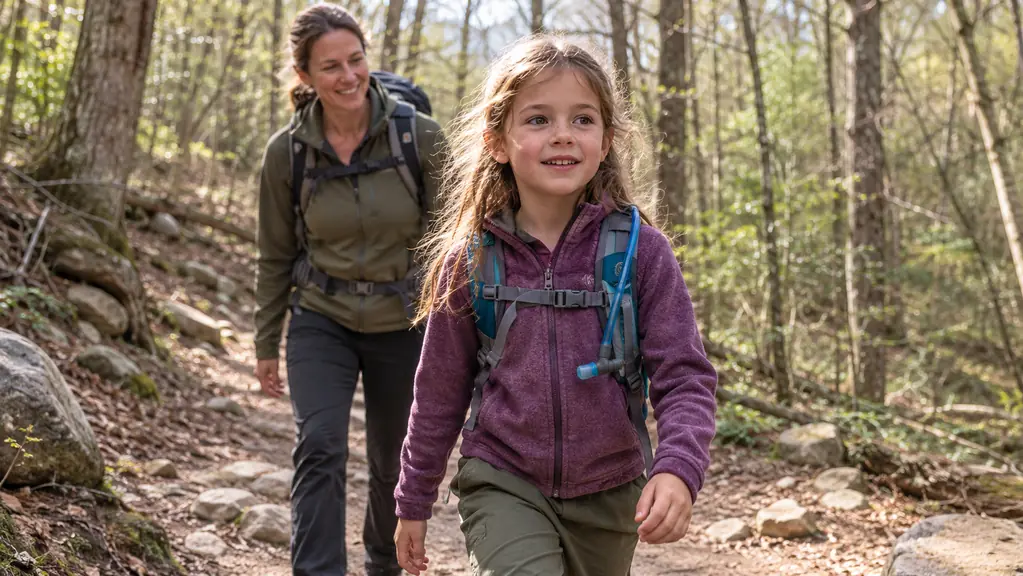
The pack Hattie has worn on thirty Saturday walks
The CamelBak Mini M.U.L.E. carries a 50 ounce reservoir and about 3.5 liters of cargo, sized for a child rather than a grown adult. It is the one piece of gear we changed first, and the only one Hattie noticed on her own.
Amazon Check Today's Price on Amazon →Step 1: Fit the pack in the driveway, not on the trail
Shoulder straps on a kids pack are almost always set too long, because somebody guessed. Put the pack on the child over the clothes she will actually walk in, not over a winter coat unless it is genuinely winter. Then look at where the bottom of the pack lands on her back.
The Mini M.U.L.E. is 14.17 inches tall and 7.48 inches wide, with shoulder straps and a sternum strap and no hip belt. That last part matters more than it sounds. Without a hip belt there is nothing to shift weight onto the hips, so the pack has to sit high and close instead of sagging down toward the tailbone. I tighten the shoulder straps until the pack lies flat against her back, then set the sternum strap across her chest so the two shoulder straps stop sliding outward. The sternum strap took Hattie a few weeks to do on her own. Until she could, I did it and let her watch where my hands went.
There is a limit to what this pack should carry. It weighs 7.05 ounces empty, it is built from polyester, and it is made for a child's water plus a few soft things. It is not a family pack. Lift it once it is loaded, and if it hangs low or the straps dig into her shoulders, it is too heavy or too long, and you fix that before you leave the driveway.
Step 2: Fill the reservoir halfway and leave the rest empty
How much water an 8 year old should drink on a two mile walk in July is a question for her pediatrician, not for me. What I can tell you is what worked in practice. The reservoir holds 1.5 liters, and I fill it about halfway, so roughly 25 ounces, for walks up to two hours. A full one is a lot of weight on a small back, and it shifts around as she walks.
On the genuinely hot days in July and August I filled it the rest of the way. Those were the only days. The half-full habit is what we kept.
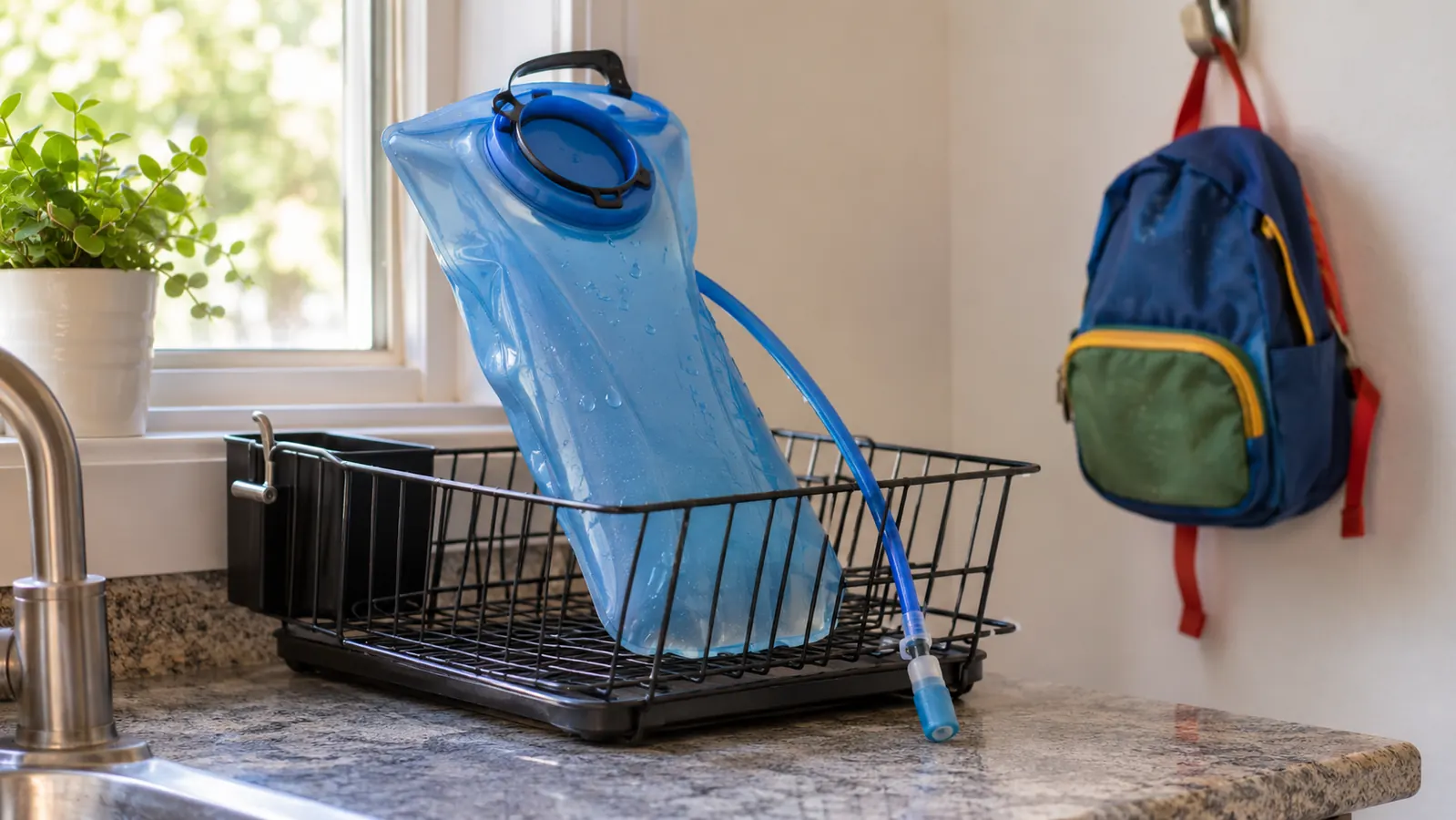
The reservoir is the part of this system that needs the most care after the walk, and this is the fault nobody warns you about. It is slow to dry. If it goes back into the pack damp, it comes out smelling like a pond. Ours lives on the dish rack by the window, propped open so air moves through it overnight. The pack itself hangs on a hook by the back door. Two pieces, two places, every single Saturday.
Step 3: Teach the bite valve in the yard, not on the trail
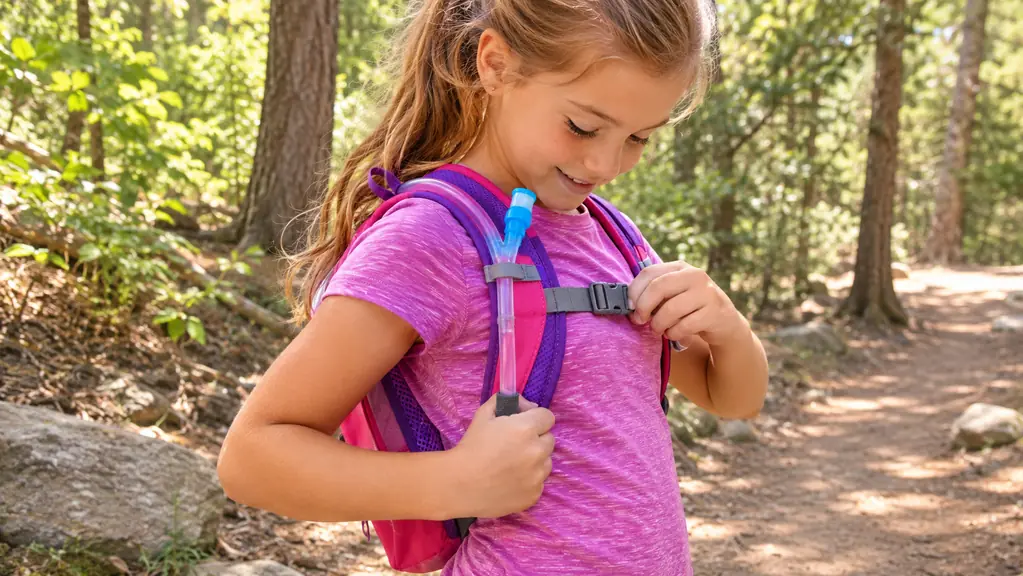
For two Saturdays Hattie carried the pack around our yard with the tube clipped to the shoulder strap and drank from it while doing nothing at all. That was the whole lesson, and it was worth the two Saturdays. A bite valve is not obvious to a child. You bite down on it and sip. If you pull on it with your teeth it can come free, which is funny exactly once and then it is annoying.
Tube length is the detail that decides whether the whole thing works. The tube should reach from the pack to her mouth with a little slack, clipped so it lies along the shoulder strap rather than across her chest. Clipped too low, she has to unclip it every time, and she will stop bothering somewhere around the first hill. Clipped too high, it swings into her face and she pulls the pack off to fix it.
One small thing to know. The bite valve drips a little if she leaves it hanging open against her shirt. Not a flood, just a wet patch. In eight months that is the only leak we have had, and it happened twice, both times when she was distracted and forgot to close it. That is not a reason to skip the pack. It is a reason to glance at the valve when you stop for a snack.
Before the pack she stopped every ten minutes or so to ask me for water. On the first walk in March she drank while she walked and did not ask once.
Step 4: Let her carry her own layers
The pack holds about 3.5 liters of cargo across three pockets, and the layout is the reason it works for a child. The main compartment takes the folded rain jacket and the binoculars. The secure zippered pocket takes the small things I do not want lost, which for us is a granola bar and a folded bandana. The stretch overflow pocket on the outside takes whatever she picks up. On a Mammoth Cave walk that is usually a leaf, a feather, or a piece of bark she is certain is a fossil.
Making her the one who carries her own jacket changes the walk in a way I did not expect. If I carry it, the answer to whether she needs it is always my answer. If it is in her pack, she makes the call at the trailhead and lives with it, and over one summer she has gotten noticeably better at that call.
The shell we pack is not insulated and does not keep her warm by itself. On cold mornings she wears a fleece underneath and the shell goes over it, and the shell only goes into the pack once she warms up. That is a fit question rather than a pack question, and it is worth putting the whole stack on her once in October, in the driveway, before you need it.
Step 5: Set a sip rhythm instead of a water break
Children do not stop to drink. They stop when something is interesting, and they drink when someone hands them something. The pack breaks that cycle by putting the water within reach while she is still moving. That leaves one job for the adult, which is the rhythm.
Our rule is simple. A few sips every time we stop to look at something. Hattie keeps a spiral notebook of what she sees on these walks and writes in it when we stop, so the notebook is the trigger. Notebook out, water first, then the entry. Over thirty Saturdays that has become automatic, and it means drinking is spaced across the whole walk instead of gulped at the end of it.
The rest is ordinary sense, and I say it as a retired teacher rather than as anyone with medical training. We walk in the morning. We turn around when the water is half gone, not when it is empty. On the days that were genuinely hot we shortened the walk to two miles. If a child is ever dull, headachy, or unusually quiet on a warm day, that is a stop, a ride home, and a call to her pediatrician. It is not a gear problem and I would not treat it as one.
What Else Helps
The pack was the first change Hattie noticed and the first thing I would buy again. It does not work alone, though, and a few of the other things in that one order are worth mentioning because they take pressure off the water question.
The boots did the most for the walking itself. Hattie wears the kids Merrell Chameleon 7 Mid A/C in a size 2, bought with about a thumb's width at the toe, worn with one pair of wool blend socks. Two short walks around our neighborhood broke them in and the blister on her left heel never came back. The grip holds on wet limestone and roots, and she could do the hook and loop strap herself from the first day. They are heavier than sneakers, clay mud packs into the tread and needs a brush, and the May morning a creek came over the top of them they spent the night on newspaper to dry.
The insulated bottle is for the other kind of walk. The Owala FreeSip in the 16 ounce size is Hattie's bottle for Lost River Cave walks under an hour, for the car, and for school. On Mammoth Cave days it stays in the Forester for the ride home. She does not carry two sources of water, because a child with two bottles drinks from neither reliably. The 16 ounce size runs out fast on a hot afternoon, the cup has to be hand washed, and the push button was stiff under small thumbs for the first couple of weeks.
Two more things earn their place in the pack. The rain jacket rides in the main compartment rolled up, rain or not, and has kept her top half dry through one real downpour and a good deal of drizzle. And the small binoculars are the reason she stops at all, which is the reason the notebook comes out, which is the reason she drinks. Her life list is at 31 species. Her first one with them was a pileated woodpecker at Mammoth Cave in March.
Change how the water is carried before you change anything else
Boots matter and jackets matter, but the pack is what ended the hand-out-and-wait cycle on our walks. The CamelBak Mini M.U.L.E. carries 50 ounces of water and 3.5 liters of cargo on a child's back, with a sternum strap to keep it steady on the climbs.
Amazon Check Today's Price on Amazon →