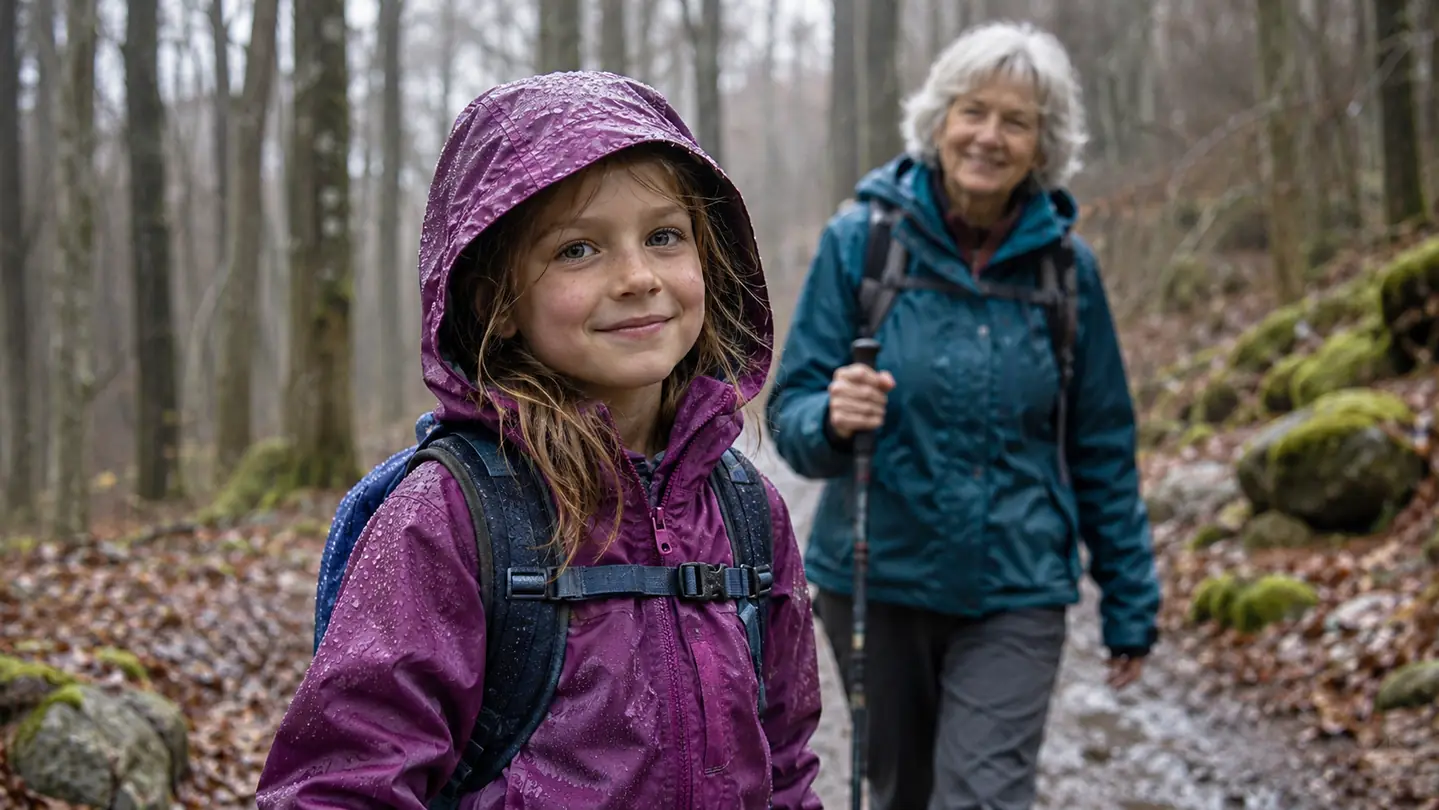
The forecast said a thirty percent chance of rain, which is the forecast that gets you. It does not sound like a storm, so the rain gear stays in the car, and then about a mile up the trail the sky changes its mind and you are standing under a hemlock with a wet eight year old asking how much further. I have been that grandmother. I would rather not be again, and it took one bad Saturday to fix it.
What changed was not a big purchase or a clever trick. One Saturday in February I took my granddaughter Hattie out to Mammoth Cave in old sneakers with a thin poncho folded into my tote. The poncho tore on a branch before we had gone a mile. Her socks were soaked, a blister was starting on her left heel, and she spent the walk back asking me for water because the only bottle we had was a leaky plastic one. That night I sat at the kitchen table and ordered five things in a single order. One of them was the Columbia Youth Glennaker Rain Jacket, and it is the piece this article is about.
The one piece of the five I would buy again tomorrow
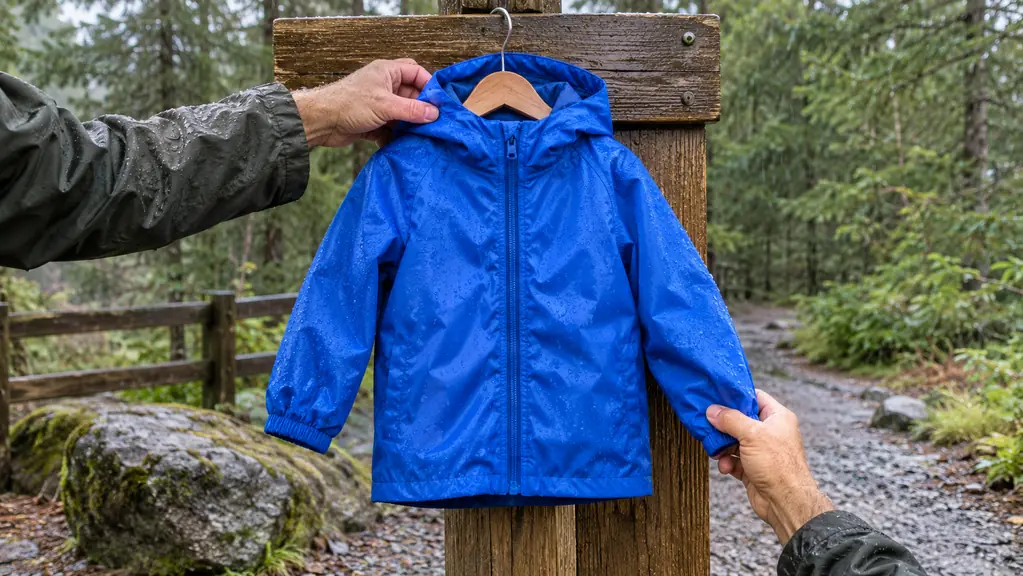
A nylon shell with a hood, a zip front and two slant pockets, and it machine washes. It rolls up smaller than a sweatshirt and lives in her pack whether the forecast mentions rain or not. Hattie wears a Youth Medium, one size up so a fleece fits underneath.
Amazon Check Today's Price on Amazon →We have used it now for about eight months, thirty Saturdays or so, through spring, a hot summer and into fall. What follows is the order I actually dress her in, the two things I got wrong in the first month, and the afternoon that made me stop second guessing the whole idea.
Step 1: Start with the layer that touches her skin
Most parents I talk to start with the jacket. I did too, for years, and it is backwards. A rain shell keeps water off the outside of a child. It cannot dry a shirt that is already damp against her back, and a damp cotton t-shirt on a fifty degree morning will make a child miserable faster than the rain ever will.
So step one happens at home, before the jacket comes off the hook. One pair of wool blend socks, not cotton. Cotton holds water against skin and stays cold against skin, and wet cotton socks are how you get the blister Hattie got in February. A synthetic or wool t-shirt under everything else. Leggings or quick drying pants rather than jeans, because jeans are heavy when they are wet and they stay heavy all day, and a child in heavy pants walks slower and complains sooner.
None of this is expensive and none of it is specific to any brand. It is just the order of operations. Get the layer that touches her skin right, and the Columbia jacket on top of it has far less work to do.
Step 2: Put a warm layer in the middle, because a shell is not a coat
The Glennaker is a shell. Columbia builds it from nylon with a hood and a zip front, and there is nothing inside it to hold warmth. On a mild rainy day that is exactly what you want, because a child bundled into an insulated rain coat on a fifty eight degree morning overheats within a quarter mile.
On a cold rainy day the shell is not enough by itself, and a shivering child will tell you so quickly. So in spring and fall a fleece goes underneath. That is the main reason I bought the jacket a size up. On a warm rainy morning in summer the fleece stays home and she wears the shell over a t-shirt, and this is where the jacket shows its one real weakness.
Nylon does not breathe much. Hattie has come back clammy on a muggy June morning when the rain was light and the air was heavy. She was not wet from the sky. She was damp from herself. I opened the zip, we sat on a log for five minutes and she was fine, but it is worth knowing before you go, because a child who is clammy at mile one will not want to be there at mile two. That is the honest trade of a waterproof shell. You get rain protection and you give up breathability. If your walks are two or three miles and the rain is real, take the trade.
Step 3: Size the jacket for the layer, not for the child
Hattie wears a Youth Medium and she is a small eight year old. I bought the Columbia Youth Glennaker a size up on purpose, so a fleece fits underneath without being squashed flat and so she gets two seasons out of it. The sleeves run a little long, which I first thought was a problem and now think is a feature. Long sleeves mean the water runs off the end of the sleeve instead of soaking the cuff and creeping up her wrist.
The cut is regular and the two slant pockets sit roughly where her hands actually land, which sounds like nothing and is not. The whole feature list is a hood, a zip front and those pockets. No insulation, nothing to adjust, nothing to snap off in a thicket. For an eight year old that simplicity is the point, because there is nothing on this jacket she can break or get confused by at the trailhead.
One caution about sizing up. Go up one size, not two. Two sizes and the hood swallows her head, the hem hangs past her hips, and the jacket turns into a costume she will argue with you about every Saturday. It is machine washable too, which matters more than I expected, because anything that lives in a pack picks up a smell by August.
Step 4: Set the hood, the zip and her hands before she leaves the car
The hood is loose on its own. That is the one adjustment I make every single time. On a rainy morning under about fifty five degrees, Hattie wears a thin beanie under the hood, and the hood then stays where she puts it. Without the hat it slides back, she spends the walk pushing it up with a wet hand, and rain goes down the back of her neck. That is how a child decides she hates hiking.
Zip it to the chin before she gets out of the car, not on the trail. Same with her hands: the two slant pockets are where they go, and I have her put them in while I check the pack. It takes thirty seconds at the trailhead and it saves ten minutes of fussing at the first bend.
I also check that the sleeves are not bunched up inside the cuffs of her fleece. If they are, water wicks down inside the jacket sleeve and the whole arrangement fails at the wrist. Pull the fleece sleeve straight, then let the jacket sleeve fall over it, and the water leaves at the cuff the way it is supposed to.
Step 5: Let her run the jacket herself
This is the step that matters most and the one adults skip. Hattie gets the jacket out of the pack herself when it starts to rain, and she puts it on herself. She could work the zip from the first week. She was slower with the sternum strap on her pack, which took a few weeks to manage on her own, but the jacket zip gave her no trouble at all.
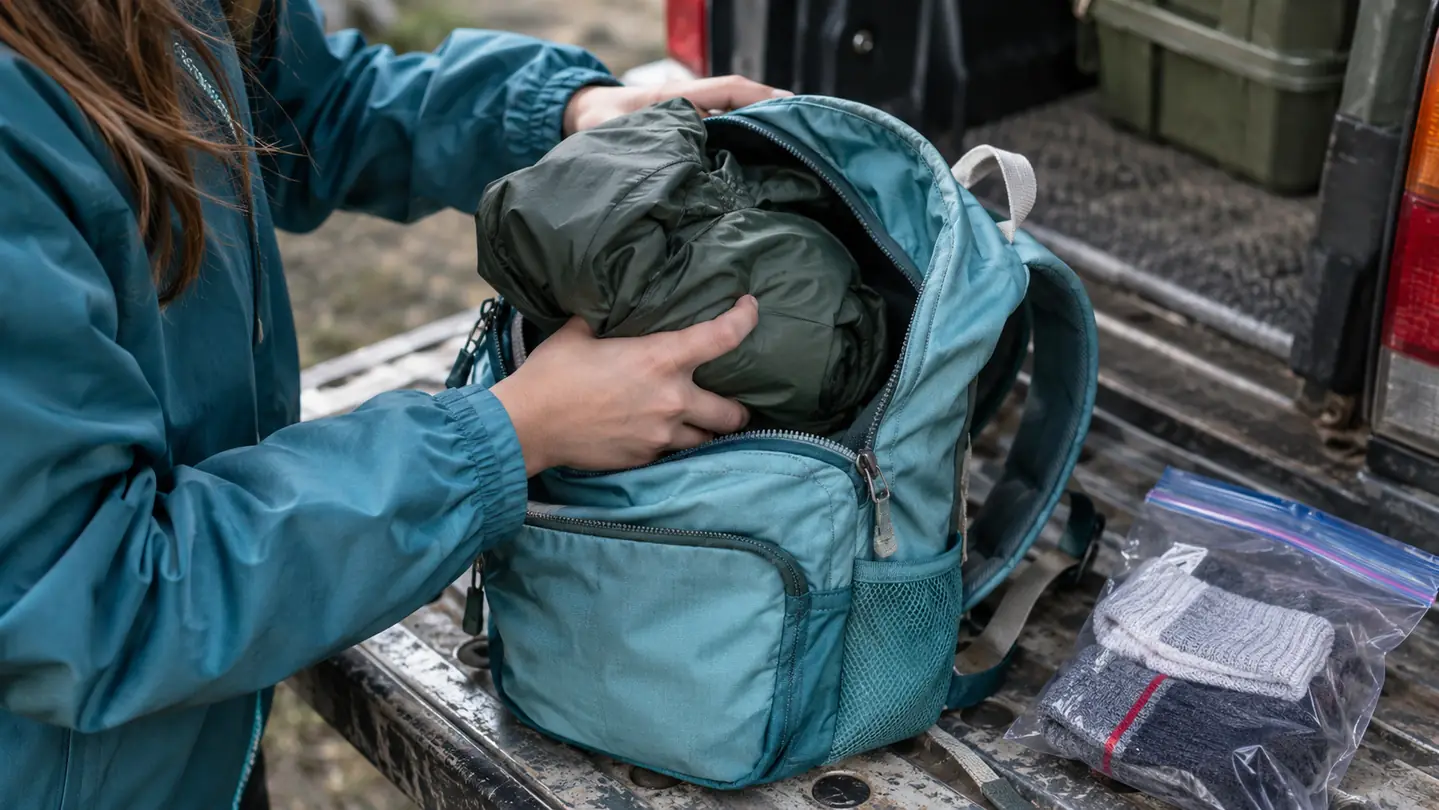
The jacket rides rolled up in the main compartment of her pack on every Mammoth Cave walk, rain or not. Not in my tote. Not in the car. If it lives in my tote she has to ask me for it and the walk stops while I dig, and if it lives in the car it is a mile behind us when the sky opens. If it lives in her pack she feels the first drops, stops and handles it. That one change did more for her confidence than any speech I could have given her about being prepared.
The afternoon that settled it was a Saturday in late April at Mammoth Cave. The rain came in about a mile from the car and stayed. We had maybe twenty five minutes of walking to get back. Her top half stayed completely dry under the jacket. Her pants were soaked through, because I had not bought rain pants yet, and the water ran down into her boots at the ankle. She laughed the whole way back. Twenty five minutes of real rain, and the only part of her that suffered was the part I had not thought about.
What Else Helps
Rain pants. That is the gap the April afternoon exposed. The jacket keeps everything above the waist dry and then hands the problem to the pants, and soaked pants wick water down into the boots, which is the exact wet sock problem I started this whole thing to fix. If your child is going to walk in real rain rather than drizzle, buy the pants in the same order as the jacket. I learned that the hard way so you do not have to.
Spare socks in a zip bag in the pack. One pair, nothing more. If the boots do take on water, dry socks at the car turn a ruined Saturday into a story. Hattie's Merrell boots are waterproof and ankle high, but no boot is waterproof over the top, and water coming in over the ankle beats any boot ever made.
A plastic bag for the nature journal. Hattie keeps one spiral notebook for what she sees, my idea from the classroom years, and her bird list is at thirty one species now. A wet notebook ends that habit in a single afternoon. The binoculars stay in the pack's main compartment at Mammoth Cave and around her neck at Lost River, and they have only ever been out in light drizzle. I would not push that. They are not something I intend to test in a downpour.
And the bottle. On the short walks at Lost River, Hattie carries her Owala. On the longer Mammoth Cave walks it stays in the Forester for the ride home and her pack carries the water, because a sixteen ounce bottle runs out fast on a hot morning and I got tired of being asked. The pack also holds the jacket, the binoculars, the journal and a snack, which is the real reason the jacket has to roll small. A rain coat that only folds down to the size of a loaf of bread will end up left at home.
Twenty five minutes of real rain, about a mile from the car, and her top half stayed completely dry. Her pants were soaked through, because that was the part I had not thought about.
One shell, sized up, living in her pack instead of mine
The Columbia Youth Glennaker is a nylon shell with a hood, a zip front and two slant pockets, and it machine washes. It is not warm on its own, and it gets clammy on a muggy morning. It also kept an eight year old's top half dry for twenty five minutes of real rain a mile from the car, which is all I ever actually wanted from it.
Amazon Check Today's Price on Amazon →