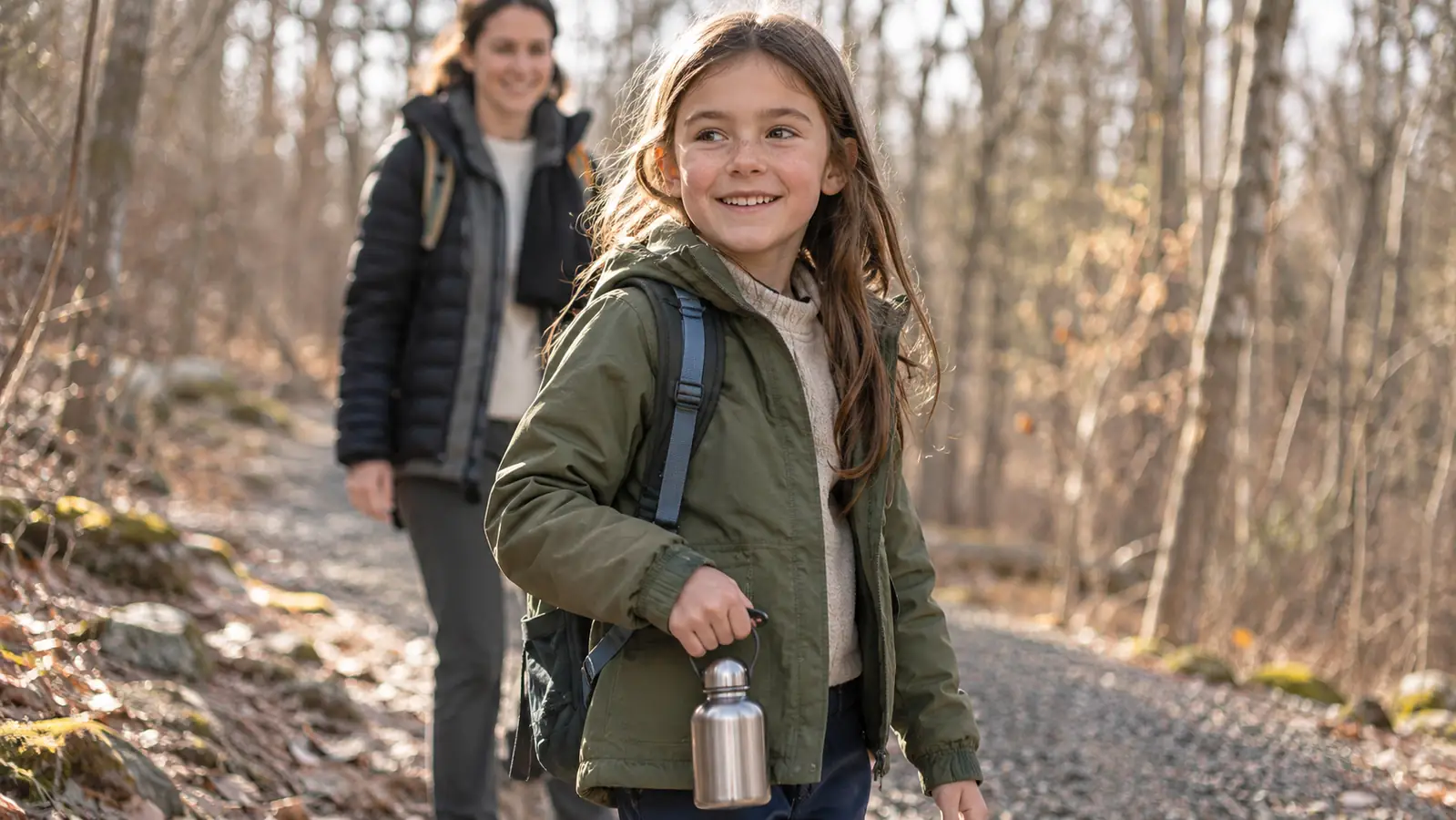
The first thing I want to say about the Owala FreeSip Kids bottle is that it is not the bottle that carries my granddaughter's water up a trail. That job belongs to the small hydration pack she wears, and it has belonged to it since the first Saturday in March. The Owala is what she drinks from in the car on the way to Lost River Cave, what goes to school with her every morning, and what sits in the cup holder of my Forester while we are two miles out on a surface trail at Mammoth Cave. Knowing that up front will keep you from buying the wrong bottle for the wrong job, and it will also explain why I have a stronger opinion about the lid than about anything else on this page.
I ordered it in February, in the same order as four other things, on the night I got tired of being the grandmother who sends a child home with wet socks. Hattie is eight and in third grade, and she spends every Saturday with me because her parents both work Saturdays. We walk two or three miles most weeks. The bottle has been in our routine about eight months now, through spring, a hot summer and the start of fall, and I have washed it more times than I can count. This is not a first impression. It is the honest version, including the parts the product page does not lead with.
Here is the short version. The lid is the reason to buy this bottle and the lid is the reason some people end up cross with it. It has a push button, a spout you can sip through a built-in straw or tip back and swig from, and a carry loop that flips over the button to lock it. An eight year old can run all of that by herself. She just cannot do it on day one, and nobody tells you that part.
The Quick Verdict
A good kids bottle with a two-way lid that rewards a week of practice, a body that keeps ice through a July morning, and a sixteen ounce capacity that runs dry on a hot afternoon.
Amazon Check Today's Price →The lid is the whole reason. Look at it before you decide.
Sixteen ounces of insulated stainless steel with a FreeSip spout, a push-button lid and a carry loop that locks it shut. Check today's price on Amazon.
Amazon Check Today's Price on Amazon →How I've Used It, and What It Is Not For
On Mammoth Cave mornings the Owala stays in the car. I want to be plain about that, because sixteen ounces is not what a child drinks from over two or three miles of trail. Hattie wears the pack with the reservoir for that, and she sips from the bite valve while she walks, which was the change that stopped her asking me for water every ten minutes. The Owala is for the shorter walks at Lost River Cave in town, usually under an hour, and for the ride home when she is warm and thirsty and the reservoir is empty and I do not want to hear about it. It goes to school every day too, which is most of its life if I am honest.
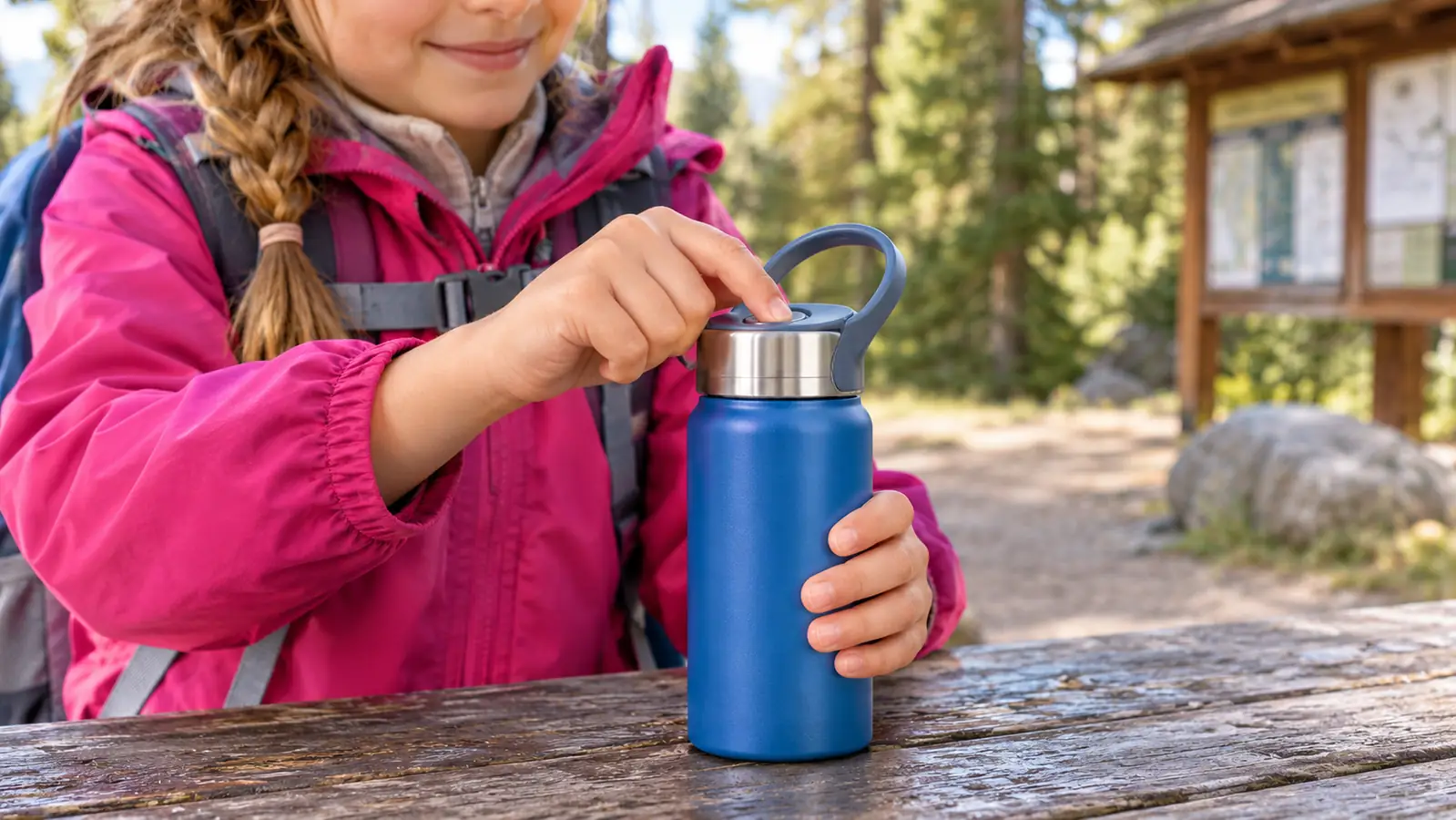
At the start she could not press the button. It is stiff, and small thumbs do not have the leverage an adult hand has. For the first two weeks she handed it to me, or she set it on the table, held the body with one hand and pushed with the heel of the other. By the third week she had it. Now she pops it open one handed in the parking lot at Lost River, and that small piece of independence is worth more to me than any insulation rating.
We put water in it and, in July, ice cubes. The opening is wide enough to drop ice in without a fight, which sounds like a small thing until you have stood at a kitchen counter trying to jam a cube through a narrow neck. That wide mouth is also why I can get a brush down inside it, and I will come back to that.
What Nobody Tells You About the FreeSip Spout
The spout does two jobs. You can sit the bottle upright and sip through the straw built into the lid, or you can tip the whole thing back and drink from the opening the way you would from a cup. That is genuinely useful with children, because it means the bottle grows with them a little. Hattie drank through the straw for about a month before she ever tried the swig side. Now she uses the straw at school, because she can keep the bottle on her desk and sip without tipping her head back, and she swigs at home when she is in a hurry.
The part I did not expect is that the straw is not a loose piece you can pull out, rinse and forget. It lives inside the lid, and the inside of that lid is where water sits if the bottle comes home half full and gets left in a bag until Monday. The wide opening helps, but the honest answer is that this bottle wants a small brush and thirty seconds of attention, or it will start to smell like a pond. That is not a flaw exactly. It is the cost of a lid that does two things instead of one.
There is a learning curve on the drinking itself, too. Hattie's first week she pulled so hard on the straw that she got a mouthful and coughed. A child who has only used a squeeze bottle or an open cup has to learn that this one gives water easily and does not need effort. It took her about three days. I mention it because if you hand this to a five year old and walk away, you should expect to be handed back a wet shirt.
Locked, it has never leaked in eight months. Unlocked, it leaked once, and once was enough to teach us both.
The Lock, the Button, and the One Leak We Had
The carry loop is the lock. That is the design, and it is clever once you see it. Flip the loop up and over and it covers the button so the button cannot be pressed. Flip it back and the button is live. For eight months the bottle has ridden in the car, been dropped on the stone steps at Lost River in June, and been shoved into a school bag next to a folder, and it has leaked exactly once.
The leak was in June, in the cup holder of the Forester. Hattie had been drinking from it, set it back down without flipping the loop over the button, and then climbed across the seat to get her notebook out of the back. The bottle tipped. When I picked it up there was a puddle in the cup holder about the size of a half dollar. Nothing dramatic, nothing that ruined anything, but it was wet and it was avoidable. Locked, that has never happened. Not once, not even lying on its side on the floor mat after a Saturday when she forgot it under the seat.
The button itself is stiff for the first couple of weeks. I said that above and I will say it again, because it is the single most likely complaint from a parent of a young child and it is temporary. Stiff is also part of why the lid does not pop open inside a bag. There is a trade there, and I come down on the side of stiff.
Then there is the dent. She dropped it on the stone steps at Lost River in June. There is a small mark near the base, maybe the size of a pea, and the bottle still stands up straight, still holds water, still holds cold. Stainless steel does that. This is not a piece of gear I would hand to a child and expect to stay pretty.
How Cold It Actually Stays
The listing says up to 24 hours, and I am not going to pretend I have measured that, because I have not. What I can tell you is what a July morning at Mammoth Cave looks like. I filled it before we left the house, dropped in three or four cubes, and it sat in the car while we walked. Three hours later, back in the parking lot, there was still ice rattling around inside it. That is the whole test I have run, and it passed.
The outside stays dry, which matters more than people think. A bottle that sweats in a school bag will soak a folder and a library book by Friday. This one has a double wall and does not do that. It weighs 322 grams empty, about eleven ounces, so it is not a featherweight, but an eight year old carries it by the loop without complaint and sets it down without dropping it.
Where it falls down is volume. Sixteen ounces is not much on a hot day. In July Hattie finished it before we got back to the car on a Lost River walk, and I refilled it from the jug I keep in the back. If your child drinks a lot, or if you are thinking of this as the only water for a long walk, it is not enough. That is not a defect. It is a sixteen ounce bottle doing a sixteen ounce job, and you should know it before you buy.
The Care Instructions Are the Real Work
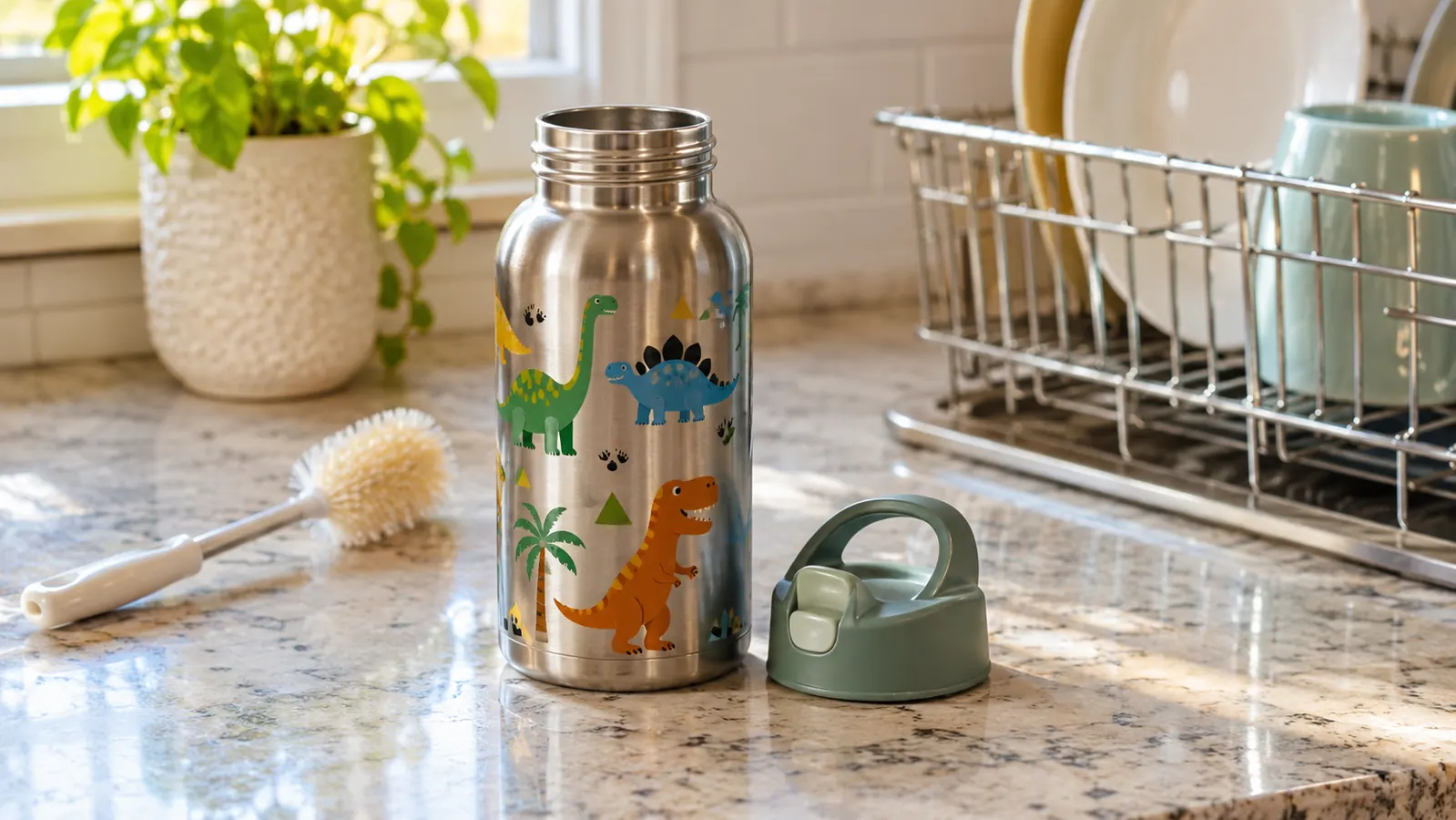
The listing calls it dishwasher safe, and I have no reason to doubt it. I still hand wash the cup. A bottle a child drinks from every day gets washed every day, and the fastest version of that for me has been warm water, a drop of soap, a bottle brush through the wide opening and a small brush through the straw end of the lid. The lid goes on the top rack when I am in a hurry. That is my routine, not a rule I am handing down to anybody.
The round body and the wide mouth make the inside easy to reach. The lid is the fussy part. There is a groove around the spout where water sits, and if you do not get a brush into it you will know by Thursday. Thirty seconds. That is the whole cost. I have spent longer than that looking for a missing mitten.
Eight Months In, What Still Works
The lid still snaps shut with the same click it had in March. The loop has not stretched. The button has not loosened, which surprised me given how many times a day it gets pressed. The straw inside the lid still lines up with the opening cleanly, and that was the failure I expected first, because a straw that lives in a hinge is a straw that can go crooked. It has not.
The mark near the base is the only scar. Nothing has chipped away around it and there is no rust, which was my other worry with a steel bottle that gets dropped on wet stone and then sits in a warm car. I am not gentle with gear and I have not been gentle with this.
The Size Question
Sixteen ounces is the right size for a car ride and a short walk, and the wrong size for a summer afternoon. I have gone back and forth on this. A bigger bottle would be heavier and Hattie would not carry it. A smaller one would be pointless. So the size is a compromise that happens to suit the way we actually use it, which is under an hour at Lost River and a ride home from Mammoth Cave.
If your Saturdays look like ours, this is the size you want. If your child is doing four miles with a pack, the pack carries the water and this bottle stays in the car, which is exactly what happens with us. I would not buy a heavier version for an eight year old to carry by the loop. I would buy this and let the pack do the heavy work.
What I Would Change
Three things. I would make the button easier to press in the first week, because the child who is most excited about a new bottle is the one least able to open it. I would offer a larger size for older children, since sixteen ounces disappears on a July morning. And I would put a small brush in the box, because the straw end needs one and most families will not think to buy it until the smell starts.
Who This Is For
This is a good bottle for a child roughly six to ten who is expected to manage her own water, and for the adult who is tired of opening bottles. The Owala lid is the reason. A child who can press a button and flip a loop has a bottle she can use in the car, at school, on a bench at Lost River, without asking anyone for help. It is also a good bottle for a parent who wants one thing in the school bag that will not soak a folder.
Who Should Skip It
Skip it if you need a bottle for a long hike, because sixteen ounces will not do it and you will spend the walk refilling. Skip it if your child is three or four and cannot yet work a stiff button, unless you are prepared to open it every single time. Skip it if you want to throw the whole thing in the dishwasher and forget it, because the lid rewards a little hand attention. And skip it if you want a bottle that stays looking new. Steel takes marks, and children drop things.
What I Liked
- The FreeSip lid gives a child two ways to drink, and she can work both herself after a week or so
- Locked, it has never leaked in eight months of school bags, car floors and one drop on stone steps
- Double wall keeps ice in it through a July morning and keeps the outside dry in a backpack
- The wide opening takes ice cubes and a bottle brush without a fight
- The carry loop is comfortable for small hands on a walk
Where It Falls Short
- Sixteen ounces runs out on a hot day and needs a refill
- The push button is stiff for small thumbs for the first couple of weeks
- The straw end of the lid needs a small brush and regular attention or it smells
- The cup gets hand washed in our house, which is a daily job
- It takes a mark when dropped on stone steps
What I'd Tell Another Grandmother
If you are buying one thing for a child this age, buy the pack for the trail. If you are buying the thing that gets used every single day, buy this. Ours has gone to school, to Lost River, to a birthday party and to the car wash, and it has come home every time. The only day it let us down was the day we did not lock it, and that was our fault, not the bottle's.
The bottle that comes home every Saturday
Sixteen ounces of insulated stainless steel, a FreeSip spout that works two ways, and a carry loop that locks the lid. Check today's price on Amazon.
Amazon Check Today's Price on Amazon →